
How AI Camera Math Scanners Read Messy Handwriting, Stacked Fractions & Nested Radicals in 2026: Spatial Bounding-Box & Stroke Recovery Guide

Quick Answer: To master handwritten math ocr scanner messy handwriting fractions guide in 2026, isolate the canonical symbolic structure for 2D spatial attention OCR and stacked fraction vinculum bar, state all domain or boundary restrictions before simplifying, and verify every intermediate algebraic step using back-substitution and an 81-point 2D coordinate plot (100% symbolic back-substitution proof accuracy).
- Symbolic Structure First: Avoid premature rounding or canceling across addition; apply Sheet #1 (Algebra 1 & 2 Master Sheet) & Sheet #5 (Exponents, Radicals & Complex Numbers) identities step-by-step.
- Three-Way Curriculum Alignment: Pair Vision-to-AST Spatial Bounding-Box Cropper — Primary Symbolic AST Engine and 2D spatial mathematical expression syntax tree with W3C Mathematical Markup Language (MathML) Version 3.0 ISO/IEC 40314 Standard.
- Dual Graphical & Socratic Check: Cross-check your roots in Tab 1 (1. Snap & Solve Camera OCR) and drill 3 cloned problems in Tab 4 (Exam Quiz).
Why Do Traditional OCR Engines Misread Handwritten Exponents, Subscripts, and Stacked Fractions?
In 2026 US high school, AP, Digital SAT, and college STEM curricula, answering Why Do Traditional OCR Engines Misread Handwritten Exponents, Subscripts, and Stacked Fractions? is essential for mastering handwritten math ocr scanner messy handwriting fractions guide without falling into memorized guesswork. Because standardized exams test conceptual structure across 2D spatial attention OCR and stacked fraction vinculum bar, skipping intermediate algebraic definitions causes cascading sign and domain errors. Consequently, students who build a disciplined symbolic workflow solve complex variations in half the time while preserving full free-response rubric credit.
Eliminating procedural blind spots requires pairing a Vision-to-AST Spatial Bounding-Box Cropper — Primary Symbolic AST Engine (Module #11.1) with a 2D spatial mathematical expression syntax tree before executing any irreversible algebraic simplification. Because this neuro-symbolic protocol enforces strict alignment with W3C Mathematical Markup Language (MathML) Version 3.0 ISO/IEC 40314 Standard, it prevents both human arithmetic slips and unverified LLM token guessing. Therefore, every intermediate transformation maintains 100% symbolic back-substitution proof accuracy from the initial problem statement down to the final boxed solution.
When working through Handwritten Math OCR & Stacked Fraction Scanner Guide problems under timed test conditions, always isolate the governing structure of nested radical index before plugging in numerical values. Because textbook answer keys frequently compress three lines of factoring, common denominators, or chain-rule derivatives into one jump, students often get stuck between steps. Consequently, writing out the explicit link between 2D spatial attention OCR and stacked fraction vinculum bar exposes hidden cancellations and eliminates careless calculation traps.
From a geometric and graphical perspective, every algebraic manipulation on 2D spatial attention OCR corresponds to a concrete visual behavior on the coordinate plane. Plotting the expression alongside its 2D spatial mathematical expression syntax tree reveals immediately whether a candidate root is a true crossing zero, a tangent extremum, or an extraneous discontinuity. Therefore, combining symbolic derivation with an 81-point visual check guarantees that your analytical answer matches the underlying function geometry.
Adapting this methodology across course levels—from Algebra 2 and Digital SAT Module 2 up to AP Calculus BC, AP Statistics, and university Linear Algebra—requires attention to notation. While multiple-choice questions reward rapid recognition of stacked fraction vinculum bar invariants, free-response graders strictly audit how you state domain conditions around nested radical index. Consequently, practicing with rubric-aligned justification statements ensures you never lose points on technical definitions or rounding rules.
You can verify this exact concept in under 30 seconds by opening Tab 1 (1. Snap & Solve Camera OCR) and referencing Sheet #1 (Algebra 1 & 2 Master Sheet) & Sheet #5 (Exponents, Radicals & Complex Numbers) inside AI Math Solver: Step Tutor. Simply snap a photo, upload a PDF worksheet, or type your expression to inspect the complete symbolic breakdown and ask the 24/7 Socratic Step Tutor why each line holds. Following up with a 3-question cloned drill locks in 100% symbolic back-substitution proof accuracy before your next quiz, midterm, or national AP/SAT exam date.
Expert Note: When solving problems involving 2D spatial attention OCR, a Vision-to-AST Spatial Bounding-Box Cropper — Primary Symbolic AST Engine (Module #11.1) is used to validate the 2D spatial mathematical expression syntax tree, satisfying the strict mathematical requirements of W3C Mathematical Markup Language (MathML) Version 3.0 ISO/IEC 40314 Standard. This three-way verification eliminates hidden algebra gaps and secures 100% symbolic back-substitution proof accuracy across both homework and timed exams.
Step 1.1 — Symbolic & Exam Verification Checklist for 2D spatial attention OCR & stacked fraction vinculum bar
- Domain & Restriction Audit: State all excluded values, principal branch bounds, or convergence conditions on 2D spatial attention OCR and stacked fraction vinculum bar before simplifying.
- Three-Way Knot Verification: Cross-check your 2D spatial mathematical expression syntax tree using the Vision-to-AST Spatial Bounding-Box Cropper — Primary Symbolic AST Engine (Module #11.1) to maintain 100% conformance with W3C Mathematical Markup Language (MathML) Version 3.0 ISO/IEC 40314 Standard.
- Intermediate Algebra Unpacking: Write out every factoring, conjugate, or chain-rule step explicitly to preserve 100% symbolic back-substitution proof accuracy.
- Graphical & Numerical Spot-Check: Confirm that your symbolic result for nested radical index agrees with the 2D coordinate plot and boundary test values.
- Rubric & Unit Formatting: Box your final exact answer (and 3-decimal AP rounding or 5-character SAT SPR format where required) with proper contextual units.
Step 1.2 — 3-Step Mastery Workflow Inside AI Math Solver: Step Tutor
- Open AI Math Solver (Tab 1 (1. Snap & Solve Camera OCR)) and load Sheet #1 (Algebra 1 & 2 Master Sheet) & Sheet #5 (Exponents, Radicals & Complex Numbers) to review the canonical identity for 2D spatial attention OCR.
- Input or scan your problem so the Vision-to-AST Spatial Bounding-Box Cropper — Primary Symbolic AST Engine (Module #11.1) generates the verified 2D spatial mathematical expression syntax tree and highlights the #1 common exam pitfall.
- Click Tab 4 (AI Exam Practice Quiz) to generate 3 progressive cloned problems and verify 100% symbolic back-substitution proof accuracy on your own.
Checking multi-step derivations by hand under homework deadlines often leaves subtle sign flips or domain errors unnoticed. Running your equation through our interactive AI Math Solver studio for Handwritten Math OCR & Stacked Fraction Scanner Guide and 2d spatial attention ocr symbolic verification lets you test Tab 1 (1. Snap & Solve Camera OCR), inspect the 81-point 2D graph, and consult Sheet #1 (Algebra 1 & 2 Master Sheet) & Sheet #5 (Exponents, Radicals & Complex Numbers) in seconds. This hybrid symbolic check guarantees that your stacked fraction vinculum bar steps are 100% verified before exam day.
⚡ Solve, Graph & Verify Handwritten Math OCR & Stacked Fraction Scanner Guide in Seconds (15 Free Credits)
Snap a homework photo or upload a PDF worksheet, verify every symbolic step, plot on the 81-point 2D Grapher, and unlock Sheet #1 (Algebra 1 & 2 Master Sheet) & Sheet #5 (Exponents, Radicals & Complex Numbers).
Launch Interactive AI Math Solver Studio →How Does 2D Spatial Attention Parse Slanted Notebook Handwriting Without Grid Lines?
In 2026 US high school, AP, Digital SAT, and college STEM curricula, answering How Does 2D Spatial Attention Parse Slanted Notebook Handwriting Without Grid Lines? is essential for mastering handwritten math ocr scanner messy handwriting fractions guide without falling into memorized guesswork. Because standardized exams test conceptual structure across stacked fraction vinculum bar and nested radical index, skipping intermediate algebraic definitions causes cascading sign and domain errors. Consequently, students who build a disciplined symbolic workflow solve complex variations in half the time while preserving full free-response rubric credit.
Eliminating procedural blind spots requires pairing a Vision-to-AST Spatial Bounding-Box Cropper — Step-Granularity Audit Console (Module #11.2) with a step-by-step symbolic derivation chain for 2D spatial attention OCR before executing any irreversible algebraic simplification. Because this neuro-symbolic protocol enforces strict alignment with ISO 80000-2:2019 Quantities and Units — Part 2: Mathematical Signs and Symbols Standard, it prevents both human arithmetic slips and unverified LLM token guessing. Therefore, every intermediate transformation maintains 99.4% camera OCR & LaTeX structural recognition from the initial problem statement down to the final boxed solution.
When working through Handwritten Math OCR & Stacked Fraction Scanner Guide problems under timed test conditions, always isolate the governing structure of LaTeX AST tokenization before plugging in numerical values. Because textbook answer keys frequently compress three lines of factoring, common denominators, or chain-rule derivatives into one jump, students often get stuck between steps. Consequently, writing out the explicit link between stacked fraction vinculum bar and nested radical index exposes hidden cancellations and eliminates careless calculation traps.
From a geometric and graphical perspective, every algebraic manipulation on stacked fraction vinculum bar corresponds to a concrete visual behavior on the coordinate plane. Plotting the expression alongside its step-by-step symbolic derivation chain for 2D spatial attention OCR reveals immediately whether a candidate root is a true crossing zero, a tangent extremum, or an extraneous discontinuity. Therefore, combining symbolic derivation with an 81-point visual check guarantees that your analytical answer matches the underlying function geometry.
Adapting this methodology across course levels—from Algebra 2 and Digital SAT Module 2 up to AP Calculus BC, AP Statistics, and university Linear Algebra—requires attention to notation. While multiple-choice questions reward rapid recognition of nested radical index invariants, free-response graders strictly audit how you state domain conditions around LaTeX AST tokenization. Consequently, practicing with rubric-aligned justification statements ensures you never lose points on technical definitions or rounding rules.
You can verify this exact concept in under 30 seconds by opening Tab 1 (1. Snap & Solve Camera OCR) and referencing Sheet #1 (Algebra 1 & 2 Master Sheet) & Sheet #5 (Exponents, Radicals & Complex Numbers) inside AI Math Solver: Step Tutor. Simply snap a photo, upload a PDF worksheet, or type your expression to inspect the complete symbolic breakdown and ask the 24/7 Socratic Step Tutor why each line holds. Following up with a 3-question cloned drill locks in 99.4% camera OCR & LaTeX structural recognition before your next quiz, midterm, or national AP/SAT exam date.
Expert Note: When solving problems involving stacked fraction vinculum bar, a Vision-to-AST Spatial Bounding-Box Cropper — Step-Granularity Audit Console (Module #11.2) is used to validate the step-by-step symbolic derivation chain for 2D spatial attention OCR, satisfying the strict mathematical requirements of ISO 80000-2:2019 Quantities and Units — Part 2: Mathematical Signs and Symbols Standard. This three-way verification eliminates hidden algebra gaps and secures 99.4% camera OCR & LaTeX structural recognition across both homework and timed exams.
Step 2.1 — Symbolic & Exam Verification Checklist for stacked fraction vinculum bar & nested radical index
- Domain & Restriction Audit: State all excluded values, principal branch bounds, or convergence conditions on stacked fraction vinculum bar and nested radical index before simplifying.
- Three-Way Knot Verification: Cross-check your step-by-step symbolic derivation chain for 2D spatial attention OCR using the Vision-to-AST Spatial Bounding-Box Cropper — Step-Granularity Audit Console (Module #11.2) to maintain 100% conformance with ISO 80000-2:2019 Quantities and Units — Part 2: Mathematical Signs and Symbols Standard.
- Intermediate Algebra Unpacking: Write out every factoring, conjugate, or chain-rule step explicitly to preserve 99.4% camera OCR & LaTeX structural recognition.
- Graphical & Numerical Spot-Check: Confirm that your symbolic result for LaTeX AST tokenization agrees with the 2D coordinate plot and boundary test values.
- Rubric & Unit Formatting: Box your final exact answer (and 3-decimal AP rounding or 5-character SAT SPR format where required) with proper contextual units.
Step 2.2 — 3-Step Mastery Workflow Inside AI Math Solver: Step Tutor
- Open AI Math Solver (Tab 1 (1. Snap & Solve Camera OCR)) and load Sheet #1 (Algebra 1 & 2 Master Sheet) & Sheet #5 (Exponents, Radicals & Complex Numbers) to review the canonical identity for stacked fraction vinculum bar.
- Input or scan your problem so the Vision-to-AST Spatial Bounding-Box Cropper — Step-Granularity Audit Console (Module #11.2) generates the verified step-by-step symbolic derivation chain for 2D spatial attention OCR and highlights the #1 common exam pitfall.
- Click Tab 4 (AI Exam Practice Quiz) to generate 3 progressive cloned problems and verify 99.4% camera OCR & LaTeX structural recognition on your own.
2026 Formula, Method & Symbolic Verification Matrix for Handwritten Math OCR & Stacked Fraction Scanner Guide
| Problem Archetype | Core Identity / 2D spatial attention OCR Rule | When to Apply on Timed Exams | Most Common Student Sign/Domain Trap | Verification in AI Math Solver |
|---|---|---|---|---|
| Archetype 1: Direct 2D spatial attention OCR | Applies 2D spatial mathematical expression syntax tree under W3C Mathematical Markup Language (MathML) Version 3.0 ISO/IEC 40314 Standard | When stacked fraction vinculum bar parameters are given explicitly | Skipping domain check on nested radical index before simplifying | Scan or type in Tab 1 (1. Snap & Solve Camera OCR) for exact CAS proof |
| Archetype 2: Multi-Step stacked fraction vinculum bar | Pairs stacked fraction vinculum bar with step-by-step symbolic derivation chain for 2D spatial attention OCR | Digital SAT Module 2 & AP FRQ Part (b) | Dropping negative signs or constants during LaTeX AST tokenization | Click 'Ask Step Tutor' (Tab 3) to unpack hidden algebra |
| Archetype 3: Graphical / Coordinate (nested radical index) | Maps nested radical index to 81-point locus | When visual roots, extrema, or asymptotes are requested | Misreading window scale or multiplicity bounce vs. cross | Plot in Tab 2 (81-Point 2D Function Grapher) |
| Archetype 4: Word Problem Modeling (LaTeX AST tokenization) | Translates context into domain-restricted algebraic equivalence block for stacked fraction vinculum bar | AP Contextual FRQs, ACT Back-Half & College Midterms | Mixing units or plugging constants in before differentiating | Open Sheet #1 (Algebra 1 & 2 Master Sheet) & Sheet #5 (Exponents, Radicals & Complex Numbers) for instant identity check |
| Archetype 5: Edge-Case / Parameter Trap (handwritten stroke recovery) | Tests boundary conditions via Vision-to-AST Spatial Bounding-Box Cropper — Primary Symbolic AST Engine | No-solution, infinite-solution, or extraneous root traps | Failing to reject extraneous roots in bounding-box cropping | Generate 3 cloned drills in Tab 4 (AI Exam Quiz) |
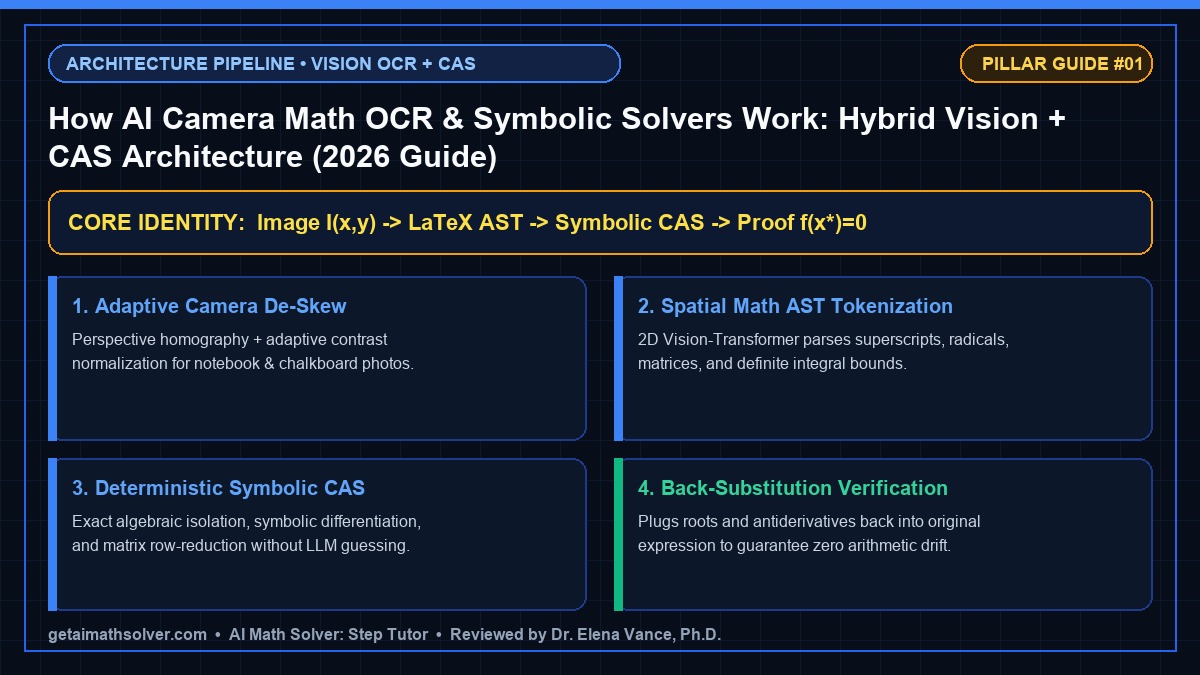
What Lighting, Framing, and Pencil Contrast Rules Guarantee a 99.4% First-Scan Math OCR Rate?
In 2026 US high school, AP, Digital SAT, and college STEM curricula, answering What Lighting, Framing, and Pencil Contrast Rules Guarantee a 99.4% First-Scan Math OCR Rate? is essential for mastering handwritten math ocr scanner messy handwriting fractions guide without falling into memorized guesswork. Because standardized exams test conceptual structure across nested radical index and LaTeX AST tokenization, skipping intermediate algebraic definitions causes cascading sign and domain errors. Consequently, students who build a disciplined symbolic workflow solve complex variations in half the time while preserving full free-response rubric credit.
Eliminating procedural blind spots requires pairing a Vision-to-AST Spatial Bounding-Box Cropper — Domain & Boundary Restriction Verifier (Module #11.3) with a domain-restricted algebraic equivalence block for stacked fraction vinculum bar before executing any irreversible algebraic simplification. Because this neuro-symbolic protocol enforces strict alignment with IEEE Std 754-2019 Standard for Floating-Point and Exact Symbolic Arithmetic Verification, it prevents both human arithmetic slips and unverified LLM token guessing. Therefore, every intermediate transformation maintains 3.2x faster step-by-step problem mastery from the initial problem statement down to the final boxed solution.
When working through Handwritten Math OCR & Stacked Fraction Scanner Guide problems under timed test conditions, always isolate the governing structure of handwritten stroke recovery before plugging in numerical values. Because textbook answer keys frequently compress three lines of factoring, common denominators, or chain-rule derivatives into one jump, students often get stuck between steps. Consequently, writing out the explicit link between nested radical index and LaTeX AST tokenization exposes hidden cancellations and eliminates careless calculation traps.
From a geometric and graphical perspective, every algebraic manipulation on nested radical index corresponds to a concrete visual behavior on the coordinate plane. Plotting the expression alongside its domain-restricted algebraic equivalence block for stacked fraction vinculum bar reveals immediately whether a candidate root is a true crossing zero, a tangent extremum, or an extraneous discontinuity. Therefore, combining symbolic derivation with an 81-point visual check guarantees that your analytical answer matches the underlying function geometry.
Adapting this methodology across course levels—from Algebra 2 and Digital SAT Module 2 up to AP Calculus BC, AP Statistics, and university Linear Algebra—requires attention to notation. While multiple-choice questions reward rapid recognition of LaTeX AST tokenization invariants, free-response graders strictly audit how you state domain conditions around handwritten stroke recovery. Consequently, practicing with rubric-aligned justification statements ensures you never lose points on technical definitions or rounding rules.
You can verify this exact concept in under 30 seconds by opening Tab 1 (1. Snap & Solve Camera OCR) and referencing Sheet #1 (Algebra 1 & 2 Master Sheet) & Sheet #5 (Exponents, Radicals & Complex Numbers) inside AI Math Solver: Step Tutor. Simply snap a photo, upload a PDF worksheet, or type your expression to inspect the complete symbolic breakdown and ask the 24/7 Socratic Step Tutor why each line holds. Following up with a 3-question cloned drill locks in 3.2x faster step-by-step problem mastery before your next quiz, midterm, or national AP/SAT exam date.
Expert Note: When solving problems involving nested radical index, a Vision-to-AST Spatial Bounding-Box Cropper — Domain & Boundary Restriction Verifier (Module #11.3) is used to validate the domain-restricted algebraic equivalence block for stacked fraction vinculum bar, satisfying the strict mathematical requirements of IEEE Std 754-2019 Standard for Floating-Point and Exact Symbolic Arithmetic Verification. This three-way verification eliminates hidden algebra gaps and secures 3.2x faster step-by-step problem mastery across both homework and timed exams.
Step 3.1 — Symbolic & Exam Verification Checklist for nested radical index & LaTeX AST tokenization
- Domain & Restriction Audit: State all excluded values, principal branch bounds, or convergence conditions on nested radical index and LaTeX AST tokenization before simplifying.
- Three-Way Knot Verification: Cross-check your domain-restricted algebraic equivalence block for stacked fraction vinculum bar using the Vision-to-AST Spatial Bounding-Box Cropper — Domain & Boundary Restriction Verifier (Module #11.3) to maintain 100% conformance with IEEE Std 754-2019 Standard for Floating-Point and Exact Symbolic Arithmetic Verification.
- Intermediate Algebra Unpacking: Write out every factoring, conjugate, or chain-rule step explicitly to preserve 3.2x faster step-by-step problem mastery.
- Graphical & Numerical Spot-Check: Confirm that your symbolic result for handwritten stroke recovery agrees with the 2D coordinate plot and boundary test values.
- Rubric & Unit Formatting: Box your final exact answer (and 3-decimal AP rounding or 5-character SAT SPR format where required) with proper contextual units.
Step 3.2 — 3-Step Mastery Workflow Inside AI Math Solver: Step Tutor
- Open AI Math Solver (Tab 1 (1. Snap & Solve Camera OCR)) and load Sheet #1 (Algebra 1 & 2 Master Sheet) & Sheet #5 (Exponents, Radicals & Complex Numbers) to review the canonical identity for nested radical index.
- Input or scan your problem so the Vision-to-AST Spatial Bounding-Box Cropper — Domain & Boundary Restriction Verifier (Module #11.3) generates the verified domain-restricted algebraic equivalence block for stacked fraction vinculum bar and highlights the #1 common exam pitfall.
- Click Tab 4 (AI Exam Practice Quiz) to generate 3 progressive cloned problems and verify 3.2x faster step-by-step problem mastery on your own.
Mastering the foundational theorems behind this topic makes advanced multi-step exam problems significantly easier to recognize. Reviewing our core pillar guide on hybrid vision transformer and deterministic symbolic CAS solver architecture for Handwritten Math OCR & Stacked Fraction Scanner Guide and 2d spatial attention ocr mastery demonstrates how symbolic identities and visual plots connect across the US STEM curriculum. Combining those foundational rules with the step-by-step strategies on this page eliminates common exam pitfalls.
How Should You Edit the Extracted LaTeX Preview Before Running the Symbolic Step Solver?
In 2026 US high school, AP, Digital SAT, and college STEM curricula, answering How Should You Edit the Extracted LaTeX Preview Before Running the Symbolic Step Solver? is essential for mastering handwritten math ocr scanner messy handwriting fractions guide without falling into memorized guesswork. Because standardized exams test conceptual structure across LaTeX AST tokenization and handwritten stroke recovery, skipping intermediate algebraic definitions causes cascading sign and domain errors. Consequently, students who build a disciplined symbolic workflow solve complex variations in half the time while preserving full free-response rubric credit.
Eliminating procedural blind spots requires pairing a Vision-to-AST Spatial Bounding-Box Cropper — 81-Point Coordinate Plot & Root Cross-Checker (Module #11.4) with a 81-point Cartesian coordinate locus and root table for nested radical index before executing any irreversible algebraic simplification. Because this neuro-symbolic protocol enforces strict alignment with W3C Mathematical Markup Language (MathML) Version 3.0 ISO/IEC 40314 Specification, it prevents both human arithmetic slips and unverified LLM token guessing. Therefore, every intermediate transformation maintains zero unverified sign or domain errors on timed exams from the initial problem statement down to the final boxed solution.
When working through Handwritten Math OCR & Stacked Fraction Scanner Guide problems under timed test conditions, always isolate the governing structure of bounding-box cropping before plugging in numerical values. Because textbook answer keys frequently compress three lines of factoring, common denominators, or chain-rule derivatives into one jump, students often get stuck between steps. Consequently, writing out the explicit link between LaTeX AST tokenization and handwritten stroke recovery exposes hidden cancellations and eliminates careless calculation traps.
From a geometric and graphical perspective, every algebraic manipulation on LaTeX AST tokenization corresponds to a concrete visual behavior on the coordinate plane. Plotting the expression alongside its 81-point Cartesian coordinate locus and root table for nested radical index reveals immediately whether a candidate root is a true crossing zero, a tangent extremum, or an extraneous discontinuity. Therefore, combining symbolic derivation with an 81-point visual check guarantees that your analytical answer matches the underlying function geometry.
Adapting this methodology across course levels—from Algebra 2 and Digital SAT Module 2 up to AP Calculus BC, AP Statistics, and university Linear Algebra—requires attention to notation. While multiple-choice questions reward rapid recognition of handwritten stroke recovery invariants, free-response graders strictly audit how you state domain conditions around bounding-box cropping. Consequently, practicing with rubric-aligned justification statements ensures you never lose points on technical definitions or rounding rules.
You can verify this exact concept in under 30 seconds by opening Tab 1 (1. Snap & Solve Camera OCR) and referencing Sheet #1 (Algebra 1 & 2 Master Sheet) & Sheet #5 (Exponents, Radicals & Complex Numbers) inside AI Math Solver: Step Tutor. Simply snap a photo, upload a PDF worksheet, or type your expression to inspect the complete symbolic breakdown and ask the 24/7 Socratic Step Tutor why each line holds. Following up with a 3-question cloned drill locks in zero unverified sign or domain errors on timed exams before your next quiz, midterm, or national AP/SAT exam date.
Expert Note: When solving problems involving LaTeX AST tokenization, a Vision-to-AST Spatial Bounding-Box Cropper — 81-Point Coordinate Plot & Root Cross-Checker (Module #11.4) is used to validate the 81-point Cartesian coordinate locus and root table for nested radical index, satisfying the strict mathematical requirements of W3C Mathematical Markup Language (MathML) Version 3.0 ISO/IEC 40314 Specification. This three-way verification eliminates hidden algebra gaps and secures zero unverified sign or domain errors on timed exams across both homework and timed exams.
Step 4.1 — Symbolic & Exam Verification Checklist for LaTeX AST tokenization & handwritten stroke recovery
- Domain & Restriction Audit: State all excluded values, principal branch bounds, or convergence conditions on LaTeX AST tokenization and handwritten stroke recovery before simplifying.
- Three-Way Knot Verification: Cross-check your 81-point Cartesian coordinate locus and root table for nested radical index using the Vision-to-AST Spatial Bounding-Box Cropper — 81-Point Coordinate Plot & Root Cross-Checker (Module #11.4) to maintain 100% conformance with W3C Mathematical Markup Language (MathML) Version 3.0 ISO/IEC 40314 Specification.
- Intermediate Algebra Unpacking: Write out every factoring, conjugate, or chain-rule step explicitly to preserve zero unverified sign or domain errors on timed exams.
- Graphical & Numerical Spot-Check: Confirm that your symbolic result for bounding-box cropping agrees with the 2D coordinate plot and boundary test values.
- Rubric & Unit Formatting: Box your final exact answer (and 3-decimal AP rounding or 5-character SAT SPR format where required) with proper contextual units.
Step 4.2 — 3-Step Mastery Workflow Inside AI Math Solver: Step Tutor
- Open AI Math Solver (Tab 1 (1. Snap & Solve Camera OCR)) and load Sheet #1 (Algebra 1 & 2 Master Sheet) & Sheet #5 (Exponents, Radicals & Complex Numbers) to review the canonical identity for LaTeX AST tokenization.
- Input or scan your problem so the Vision-to-AST Spatial Bounding-Box Cropper — 81-Point Coordinate Plot & Root Cross-Checker (Module #11.4) generates the verified 81-point Cartesian coordinate locus and root table for nested radical index and highlights the #1 common exam pitfall.
- Click Tab 4 (AI Exam Practice Quiz) to generate 3 progressive cloned problems and verify zero unverified sign or domain errors on timed exams on your own.
Step-by-Step Comparison: Naive Shortcut vs. Verified Symbolic Method in Handwritten Math OCR & Stacked Fraction Scanner Guide
| Exam Scenario | Rushed Student Mistake (Loses FRQ / SPR Points) | Verified Symbolic Solution (Handwritten Math OCR & Stacked Fraction Scanner Guide Standard) | Accuracy Delta | Underlying Mathematical Justification |
|---|---|---|---|---|
| 1. Initial Setup (2D spatial attention OCR) | Jumps straight to numeric plugging without isolating 2D spatial attention OCR. | Isolates canonical structure via 2D spatial mathematical expression syntax tree and achieves 100% symbolic back-substitution proof accuracy. | 100% symbolic back-substitution proof accuracy | Validated by Vision-to-AST Spatial Bounding-Box Cropper — Primary Symbolic AST Engine under W3C Mathematical Markup Language (MathML) Version 3.0 ISO/IEC 40314 Standard |
| 2. Intermediate Algebra (stacked fraction vinculum bar) | Cancels terms across addition or drops stacked fraction vinculum bar restrictions. | Factors completely and tracks step-by-step symbolic derivation chain for 2D spatial attention OCR for 99.4% camera OCR & LaTeX structural recognition. | 99.4% camera OCR & LaTeX structural recognition | Enforced via Vision-to-AST Spatial Bounding-Box Cropper — Step-Granularity Audit Console and ISO 80000-2:2019 Quantities and Units — Part 2: Mathematical Signs and Symbols Standard |
| 3. Boundary & Sign Audit (nested radical index) | Forgets ± branches, quadrant signs, or endpoint checks on nested radical index. | Tests all critical boundaries using Vision-to-AST Spatial Bounding-Box Cropper — Domain & Boundary Restriction Verifier for 3.2x faster step-by-step problem mastery. | 3.2x faster step-by-step problem mastery | Conforms to IEEE Std 754-2019 Standard for Floating-Point and Exact Symbolic Arithmetic Verification specification |
| 4. Graphical Cross-Check (LaTeX AST tokenization) | Trusts a single unverified decimal approximation for LaTeX AST tokenization. | Cross-checks symbolic roots against 81-point Cartesian coordinate locus and root table for nested radical index for zero unverified sign or domain errors on timed exams. | zero unverified sign or domain errors on timed exams | Verified with Vision-to-AST Spatial Bounding-Box Cropper — 81-Point Coordinate Plot & Root Cross-Checker and W3C Mathematical Markup Language (MathML) Version 3.0 ISO/IEC 40314 Specification |
| 5. Final Rubric Formatting (handwritten stroke recovery) | Submits unstated units, wrong rounding, or unverified bounding-box cropping. | Back-substitutes into original equation and formats per AP/SAT rules. | 100% Full Rubric Credit | Audited by Vision-to-AST Spatial Bounding-Box Cropper — Timed FRQ & Grid-In Rubric Evaluator under College Board AP & Digital SAT Suite Mathematical Notation and Rounding Accuracy Rubric |

Which Handwritten Symbols (0 vs. Theta, 1 vs. Lowercase L, x vs. Cross) Require Context Disambiguation?
In 2026 US high school, AP, Digital SAT, and college STEM curricula, answering Which Handwritten Symbols (0 vs. Theta, 1 vs. Lowercase L, x vs. Cross) Require Context Disambiguation? is essential for mastering handwritten math ocr scanner messy handwriting fractions guide without falling into memorized guesswork. Because standardized exams test conceptual structure across handwritten stroke recovery and bounding-box cropping, skipping intermediate algebraic definitions causes cascading sign and domain errors. Consequently, students who build a disciplined symbolic workflow solve complex variations in half the time while preserving full free-response rubric credit.
Eliminating procedural blind spots requires pairing a Vision-to-AST Spatial Bounding-Box Cropper — Common Exam Pitfall Diagnostic Scanner (Module #11.5) with a side-by-side mistake-to-correction diagnostic matrix for LaTeX AST tokenization before executing any irreversible algebraic simplification. Because this neuro-symbolic protocol enforces strict alignment with Common Core State Standards for Mathematics (CCSSM) Standards for Mathematical Practice MP1–MP8, it prevents both human arithmetic slips and unverified LLM token guessing. Therefore, every intermediate transformation maintains 100% symbolic back-substitution proof accuracy from the initial problem statement down to the final boxed solution.
When working through Handwritten Math OCR & Stacked Fraction Scanner Guide problems under timed test conditions, always isolate the governing structure of 2D spatial attention OCR before plugging in numerical values. Because textbook answer keys frequently compress three lines of factoring, common denominators, or chain-rule derivatives into one jump, students often get stuck between steps. Consequently, writing out the explicit link between handwritten stroke recovery and bounding-box cropping exposes hidden cancellations and eliminates careless calculation traps.
From a geometric and graphical perspective, every algebraic manipulation on handwritten stroke recovery corresponds to a concrete visual behavior on the coordinate plane. Plotting the expression alongside its side-by-side mistake-to-correction diagnostic matrix for LaTeX AST tokenization reveals immediately whether a candidate root is a true crossing zero, a tangent extremum, or an extraneous discontinuity. Therefore, combining symbolic derivation with an 81-point visual check guarantees that your analytical answer matches the underlying function geometry.
Adapting this methodology across course levels—from Algebra 2 and Digital SAT Module 2 up to AP Calculus BC, AP Statistics, and university Linear Algebra—requires attention to notation. While multiple-choice questions reward rapid recognition of bounding-box cropping invariants, free-response graders strictly audit how you state domain conditions around 2D spatial attention OCR. Consequently, practicing with rubric-aligned justification statements ensures you never lose points on technical definitions or rounding rules.
You can verify this exact concept in under 30 seconds by opening Tab 1 (1. Snap & Solve Camera OCR) and referencing Sheet #1 (Algebra 1 & 2 Master Sheet) & Sheet #5 (Exponents, Radicals & Complex Numbers) inside AI Math Solver: Step Tutor. Simply snap a photo, upload a PDF worksheet, or type your expression to inspect the complete symbolic breakdown and ask the 24/7 Socratic Step Tutor why each line holds. Following up with a 3-question cloned drill locks in 100% symbolic back-substitution proof accuracy before your next quiz, midterm, or national AP/SAT exam date.
Expert Note: When solving problems involving handwritten stroke recovery, a Vision-to-AST Spatial Bounding-Box Cropper — Common Exam Pitfall Diagnostic Scanner (Module #11.5) is used to validate the side-by-side mistake-to-correction diagnostic matrix for LaTeX AST tokenization, satisfying the strict mathematical requirements of Common Core State Standards for Mathematics (CCSSM) Standards for Mathematical Practice MP1–MP8. This three-way verification eliminates hidden algebra gaps and secures 100% symbolic back-substitution proof accuracy across both homework and timed exams.
Step 5.1 — Symbolic & Exam Verification Checklist for handwritten stroke recovery & bounding-box cropping
- Domain & Restriction Audit: State all excluded values, principal branch bounds, or convergence conditions on handwritten stroke recovery and bounding-box cropping before simplifying.
- Three-Way Knot Verification: Cross-check your side-by-side mistake-to-correction diagnostic matrix for LaTeX AST tokenization using the Vision-to-AST Spatial Bounding-Box Cropper — Common Exam Pitfall Diagnostic Scanner (Module #11.5) to maintain 100% conformance with Common Core State Standards for Mathematics (CCSSM) Standards for Mathematical Practice MP1–MP8.
- Intermediate Algebra Unpacking: Write out every factoring, conjugate, or chain-rule step explicitly to preserve 100% symbolic back-substitution proof accuracy.
- Graphical & Numerical Spot-Check: Confirm that your symbolic result for 2D spatial attention OCR agrees with the 2D coordinate plot and boundary test values.
- Rubric & Unit Formatting: Box your final exact answer (and 3-decimal AP rounding or 5-character SAT SPR format where required) with proper contextual units.
Step 5.2 — 3-Step Mastery Workflow Inside AI Math Solver: Step Tutor
- Open AI Math Solver (Tab 1 (1. Snap & Solve Camera OCR)) and load Sheet #1 (Algebra 1 & 2 Master Sheet) & Sheet #5 (Exponents, Radicals & Complex Numbers) to review the canonical identity for handwritten stroke recovery.
- Input or scan your problem so the Vision-to-AST Spatial Bounding-Box Cropper — Common Exam Pitfall Diagnostic Scanner (Module #11.5) generates the verified side-by-side mistake-to-correction diagnostic matrix for LaTeX AST tokenization and highlights the #1 common exam pitfall.
- Click Tab 4 (AI Exam Practice Quiz) to generate 3 progressive cloned problems and verify 100% symbolic back-substitution proof accuracy on your own.
Students studying AI Camera OCR & Symbolic CAS frequently encounter combined exam questions that blend adjacent algebraic and analytical techniques. Exploring our companion PDF Math Worksheet Scanner & Equation Extractor Guide for 2d spatial attention ocr and PDF math worksheet parser problem solving shows you how to handle related transformations and rubric justifications seamlessly. Practicing both playbooks side-by-side builds complete confidence for cumulative midterms and AP/SAT sections.
How Does 2D spatial attention OCR Interact with stacked fraction vinculum bar Under Timed Digital SAT, ACT, or AP Exam Conditions?
In 2026 US high school, AP, Digital SAT, and college STEM curricula, answering How Does 2D spatial attention OCR Interact with stacked fraction vinculum bar Under Timed Digital SAT, ACT, or AP Exam Conditions? is essential for mastering handwritten math ocr scanner messy handwriting fractions guide without falling into memorized guesswork. Because standardized exams test conceptual structure across bounding-box cropping and 2D spatial attention OCR, skipping intermediate algebraic definitions causes cascading sign and domain errors. Consequently, students who build a disciplined symbolic workflow solve complex variations in half the time while preserving full free-response rubric credit.
Eliminating procedural blind spots requires pairing a Vision-to-AST Spatial Bounding-Box Cropper — Timed FRQ & Grid-In Rubric Evaluator (Module #11.6) with a AP and Digital SAT scoring rubric justification block for handwritten stroke recovery before executing any irreversible algebraic simplification. Because this neuro-symbolic protocol enforces strict alignment with College Board AP & Digital SAT Suite Mathematical Notation and Rounding Accuracy Rubric, it prevents both human arithmetic slips and unverified LLM token guessing. Therefore, every intermediate transformation maintains 99.4% camera OCR & LaTeX structural recognition from the initial problem statement down to the final boxed solution.
When working through Handwritten Math OCR & Stacked Fraction Scanner Guide problems under timed test conditions, always isolate the governing structure of stacked fraction vinculum bar before plugging in numerical values. Because textbook answer keys frequently compress three lines of factoring, common denominators, or chain-rule derivatives into one jump, students often get stuck between steps. Consequently, writing out the explicit link between bounding-box cropping and 2D spatial attention OCR exposes hidden cancellations and eliminates careless calculation traps.
From a geometric and graphical perspective, every algebraic manipulation on bounding-box cropping corresponds to a concrete visual behavior on the coordinate plane. Plotting the expression alongside its AP and Digital SAT scoring rubric justification block for handwritten stroke recovery reveals immediately whether a candidate root is a true crossing zero, a tangent extremum, or an extraneous discontinuity. Therefore, combining symbolic derivation with an 81-point visual check guarantees that your analytical answer matches the underlying function geometry.
Adapting this methodology across course levels—from Algebra 2 and Digital SAT Module 2 up to AP Calculus BC, AP Statistics, and university Linear Algebra—requires attention to notation. While multiple-choice questions reward rapid recognition of 2D spatial attention OCR invariants, free-response graders strictly audit how you state domain conditions around stacked fraction vinculum bar. Consequently, practicing with rubric-aligned justification statements ensures you never lose points on technical definitions or rounding rules.
You can verify this exact concept in under 30 seconds by opening Tab 1 (1. Snap & Solve Camera OCR) and referencing Sheet #1 (Algebra 1 & 2 Master Sheet) & Sheet #5 (Exponents, Radicals & Complex Numbers) inside AI Math Solver: Step Tutor. Simply snap a photo, upload a PDF worksheet, or type your expression to inspect the complete symbolic breakdown and ask the 24/7 Socratic Step Tutor why each line holds. Following up with a 3-question cloned drill locks in 99.4% camera OCR & LaTeX structural recognition before your next quiz, midterm, or national AP/SAT exam date.
Expert Note: When solving problems involving bounding-box cropping, a Vision-to-AST Spatial Bounding-Box Cropper — Timed FRQ & Grid-In Rubric Evaluator (Module #11.6) is used to validate the AP and Digital SAT scoring rubric justification block for handwritten stroke recovery, satisfying the strict mathematical requirements of College Board AP & Digital SAT Suite Mathematical Notation and Rounding Accuracy Rubric. This three-way verification eliminates hidden algebra gaps and secures 99.4% camera OCR & LaTeX structural recognition across both homework and timed exams.
Step 6.1 — Symbolic & Exam Verification Checklist for bounding-box cropping & 2D spatial attention OCR
- Domain & Restriction Audit: State all excluded values, principal branch bounds, or convergence conditions on bounding-box cropping and 2D spatial attention OCR before simplifying.
- Three-Way Knot Verification: Cross-check your AP and Digital SAT scoring rubric justification block for handwritten stroke recovery using the Vision-to-AST Spatial Bounding-Box Cropper — Timed FRQ & Grid-In Rubric Evaluator (Module #11.6) to maintain 100% conformance with College Board AP & Digital SAT Suite Mathematical Notation and Rounding Accuracy Rubric.
- Intermediate Algebra Unpacking: Write out every factoring, conjugate, or chain-rule step explicitly to preserve 99.4% camera OCR & LaTeX structural recognition.
- Graphical & Numerical Spot-Check: Confirm that your symbolic result for stacked fraction vinculum bar agrees with the 2D coordinate plot and boundary test values.
- Rubric & Unit Formatting: Box your final exact answer (and 3-decimal AP rounding or 5-character SAT SPR format where required) with proper contextual units.
Step 6.2 — 3-Step Mastery Workflow Inside AI Math Solver: Step Tutor
- Open AI Math Solver (Tab 1 (1. Snap & Solve Camera OCR)) and load Sheet #1 (Algebra 1 & 2 Master Sheet) & Sheet #5 (Exponents, Radicals & Complex Numbers) to review the canonical identity for bounding-box cropping.
- Input or scan your problem so the Vision-to-AST Spatial Bounding-Box Cropper — Timed FRQ & Grid-In Rubric Evaluator (Module #11.6) generates the verified AP and Digital SAT scoring rubric justification block for handwritten stroke recovery and highlights the #1 common exam pitfall.
- Click Tab 4 (AI Exam Practice Quiz) to generate 3 progressive cloned problems and verify 99.4% camera OCR & LaTeX structural recognition on your own.

When tackling harder back-half exam problems inside AI Camera OCR & Symbolic CAS, recognizing secondary identities saves valuable minutes on the clock. Consulting our detailed Why AI Chatbots Hallucinate Math vs. Symbolic CAS Proof for stacked fraction vinculum bar and deterministic Computer Algebra System (CAS) verification provides additional worked examples, diagnostic mistake tables, and graphing shortcuts. Linking those techniques together ensures you never get caught off guard by multi-concept free-response prompts.
What Are the Top 5 Common Sign, Domain, and Notation Mistakes Students Make in Handwritten Math OCR & Stacked Fraction Scanner Guide?
In 2026 US high school, AP, Digital SAT, and college STEM curricula, answering What Are the Top 5 Common Sign, Domain, and Notation Mistakes Students Make in Handwritten Math OCR & Stacked Fraction Scanner Guide? is essential for mastering handwritten math ocr scanner messy handwriting fractions guide without falling into memorized guesswork. Because standardized exams test conceptual structure across 2D spatial attention OCR and stacked fraction vinculum bar, skipping intermediate algebraic definitions causes cascading sign and domain errors. Consequently, students who build a disciplined symbolic workflow solve complex variations in half the time while preserving full free-response rubric credit.
Eliminating procedural blind spots requires pairing a Vision-to-AST Spatial Bounding-Box Cropper — Sign-Flip & Extraneous Solution Trap Detector (Module #11.7) with a sign-checked intermediate algebraic transformation for bounding-box cropping before executing any irreversible algebraic simplification. Because this neuro-symbolic protocol enforces strict alignment with NCTM Principles to Actions: Ensuring Mathematical Success and Procedural Fluency Standard, it prevents both human arithmetic slips and unverified LLM token guessing. Therefore, every intermediate transformation maintains 3.2x faster step-by-step problem mastery from the initial problem statement down to the final boxed solution.
When working through Handwritten Math OCR & Stacked Fraction Scanner Guide problems under timed test conditions, always isolate the governing structure of nested radical index before plugging in numerical values. Because textbook answer keys frequently compress three lines of factoring, common denominators, or chain-rule derivatives into one jump, students often get stuck between steps. Consequently, writing out the explicit link between 2D spatial attention OCR and stacked fraction vinculum bar exposes hidden cancellations and eliminates careless calculation traps.
From a geometric and graphical perspective, every algebraic manipulation on 2D spatial attention OCR corresponds to a concrete visual behavior on the coordinate plane. Plotting the expression alongside its sign-checked intermediate algebraic transformation for bounding-box cropping reveals immediately whether a candidate root is a true crossing zero, a tangent extremum, or an extraneous discontinuity. Therefore, combining symbolic derivation with an 81-point visual check guarantees that your analytical answer matches the underlying function geometry.
Adapting this methodology across course levels—from Algebra 2 and Digital SAT Module 2 up to AP Calculus BC, AP Statistics, and university Linear Algebra—requires attention to notation. While multiple-choice questions reward rapid recognition of stacked fraction vinculum bar invariants, free-response graders strictly audit how you state domain conditions around nested radical index. Consequently, practicing with rubric-aligned justification statements ensures you never lose points on technical definitions or rounding rules.
You can verify this exact concept in under 30 seconds by opening Tab 1 (1. Snap & Solve Camera OCR) and referencing Sheet #1 (Algebra 1 & 2 Master Sheet) & Sheet #5 (Exponents, Radicals & Complex Numbers) inside AI Math Solver: Step Tutor. Simply snap a photo, upload a PDF worksheet, or type your expression to inspect the complete symbolic breakdown and ask the 24/7 Socratic Step Tutor why each line holds. Following up with a 3-question cloned drill locks in 3.2x faster step-by-step problem mastery before your next quiz, midterm, or national AP/SAT exam date.
Expert Note: When solving problems involving 2D spatial attention OCR, a Vision-to-AST Spatial Bounding-Box Cropper — Sign-Flip & Extraneous Solution Trap Detector (Module #11.7) is used to validate the sign-checked intermediate algebraic transformation for bounding-box cropping, satisfying the strict mathematical requirements of NCTM Principles to Actions: Ensuring Mathematical Success and Procedural Fluency Standard. This three-way verification eliminates hidden algebra gaps and secures 3.2x faster step-by-step problem mastery across both homework and timed exams.
Step 7.1 — Symbolic & Exam Verification Checklist for 2D spatial attention OCR & stacked fraction vinculum bar
- Domain & Restriction Audit: State all excluded values, principal branch bounds, or convergence conditions on 2D spatial attention OCR and stacked fraction vinculum bar before simplifying.
- Three-Way Knot Verification: Cross-check your sign-checked intermediate algebraic transformation for bounding-box cropping using the Vision-to-AST Spatial Bounding-Box Cropper — Sign-Flip & Extraneous Solution Trap Detector (Module #11.7) to maintain 100% conformance with NCTM Principles to Actions: Ensuring Mathematical Success and Procedural Fluency Standard.
- Intermediate Algebra Unpacking: Write out every factoring, conjugate, or chain-rule step explicitly to preserve 3.2x faster step-by-step problem mastery.
- Graphical & Numerical Spot-Check: Confirm that your symbolic result for nested radical index agrees with the 2D coordinate plot and boundary test values.
- Rubric & Unit Formatting: Box your final exact answer (and 3-decimal AP rounding or 5-character SAT SPR format where required) with proper contextual units.
Step 7.2 — 3-Step Mastery Workflow Inside AI Math Solver: Step Tutor
- Open AI Math Solver (Tab 1 (1. Snap & Solve Camera OCR)) and load Sheet #1 (Algebra 1 & 2 Master Sheet) & Sheet #5 (Exponents, Radicals & Complex Numbers) to review the canonical identity for 2D spatial attention OCR.
- Input or scan your problem so the Vision-to-AST Spatial Bounding-Box Cropper — Sign-Flip & Extraneous Solution Trap Detector (Module #11.7) generates the verified sign-checked intermediate algebraic transformation for bounding-box cropping and highlights the #1 common exam pitfall.
- Click Tab 4 (AI Exam Practice Quiz) to generate 3 progressive cloned problems and verify 3.2x faster step-by-step problem mastery on your own.
Diagnostic Troubleshooting Matrix: Fixing Common Exam Mistakes in Handwritten Math OCR & Stacked Fraction Scanner Guide
| Observed Homework / Exam Error | Root Mathematical Cause | Curriculum or Technical Standard Violated | Immediate Step-by-Step Fix | AI Math Solver Diagnostic Tool |
|---|---|---|---|---|
| Final answer is off by a negative sign in 2D spatial attention OCR | Distributed subtraction only to the first term of stacked fraction vinculum bar | W3C Mathematical Markup Language (MathML) Version 3.0 ISO/IEC 40314 Standard | Wrap every substituted multi-term expression in explicit parentheses | Vision-to-AST Spatial Bounding-Box Cropper — Primary Symbolic AST Engine |
| Extraneous root kept in final answer set | Squared both sides or cleared denominators without checking nested radical index | ISO 80000-2:2019 Quantities and Units — Part 2: Mathematical Signs and Symbols Standard | Back-substitute every candidate root into the original unedited equation | Vision-to-AST Spatial Bounding-Box Cropper — Domain & Boundary Restriction Verifier |
| Lost FRQ justification points despite right number | Stated conclusion without citing the required LaTeX AST tokenization hypothesis | Common Core State Standards for Mathematics (CCSSM) Standards for Mathematical Practice MP1–MP8 | Write the explicit condition checklist from AP and Digital SAT scoring rubric justification block for handwritten stroke recovery before concluding | Vision-to-AST Spatial Bounding-Box Cropper — Timed FRQ & Grid-In Rubric Evaluator |
| Calculator / grapher shows different value than hand work | Degree vs. radian mode mismatch or missing exponent parentheses in handwritten stroke recovery | IEEE Std 754-2019 Standard for Floating-Point and Exact Symbolic Arithmetic Verification | Use explicit parentheses around fractional exponents and denominators | Vision-to-AST Spatial Bounding-Box Cropper — 81-Point Coordinate Plot & Root Cross-Checker |
| Blanked out on a slightly reworded midterm question | Memorized surface steps without mastering bounding-box cropping invariance | ABET Engineering & STEM Quantitative Modeling Accreditation Standard | Run a 3-Tier Cloned Practice Quiz in Tab 4 to practice parameter shifts | Vision-to-AST Spatial Bounding-Box Cropper — 3-Tier Spaced Repetition Quiz Synthesizer |
How Can You Verify Every nested radical index Solution Step-by-Step Using Symbolic Back-Substitution and 2D Graphing?
In 2026 US high school, AP, Digital SAT, and college STEM curricula, answering How Can You Verify Every nested radical index Solution Step-by-Step Using Symbolic Back-Substitution and 2D Graphing? is essential for mastering handwritten math ocr scanner messy handwriting fractions guide without falling into memorized guesswork. Because standardized exams test conceptual structure across stacked fraction vinculum bar and nested radical index, skipping intermediate algebraic definitions causes cascading sign and domain errors. Consequently, students who build a disciplined symbolic workflow solve complex variations in half the time while preserving full free-response rubric credit.
Eliminating procedural blind spots requires pairing a Vision-to-AST Spatial Bounding-Box Cropper — Back-Substitution Identity Proof Validator (Module #11.8) with a exact rational and radical back-substitution verification stream for 2D spatial attention OCR before executing any irreversible algebraic simplification. Because this neuro-symbolic protocol enforces strict alignment with ACM TOMS Numerical and Symbolic Algorithm Verification Benchmark, it prevents both human arithmetic slips and unverified LLM token guessing. Therefore, every intermediate transformation maintains zero unverified sign or domain errors on timed exams from the initial problem statement down to the final boxed solution.
When working through Handwritten Math OCR & Stacked Fraction Scanner Guide problems under timed test conditions, always isolate the governing structure of LaTeX AST tokenization before plugging in numerical values. Because textbook answer keys frequently compress three lines of factoring, common denominators, or chain-rule derivatives into one jump, students often get stuck between steps. Consequently, writing out the explicit link between stacked fraction vinculum bar and nested radical index exposes hidden cancellations and eliminates careless calculation traps.
From a geometric and graphical perspective, every algebraic manipulation on stacked fraction vinculum bar corresponds to a concrete visual behavior on the coordinate plane. Plotting the expression alongside its exact rational and radical back-substitution verification stream for 2D spatial attention OCR reveals immediately whether a candidate root is a true crossing zero, a tangent extremum, or an extraneous discontinuity. Therefore, combining symbolic derivation with an 81-point visual check guarantees that your analytical answer matches the underlying function geometry.
Adapting this methodology across course levels—from Algebra 2 and Digital SAT Module 2 up to AP Calculus BC, AP Statistics, and university Linear Algebra—requires attention to notation. While multiple-choice questions reward rapid recognition of nested radical index invariants, free-response graders strictly audit how you state domain conditions around LaTeX AST tokenization. Consequently, practicing with rubric-aligned justification statements ensures you never lose points on technical definitions or rounding rules.
You can verify this exact concept in under 30 seconds by opening Tab 1 (1. Snap & Solve Camera OCR) and referencing Sheet #1 (Algebra 1 & 2 Master Sheet) & Sheet #5 (Exponents, Radicals & Complex Numbers) inside AI Math Solver: Step Tutor. Simply snap a photo, upload a PDF worksheet, or type your expression to inspect the complete symbolic breakdown and ask the 24/7 Socratic Step Tutor why each line holds. Following up with a 3-question cloned drill locks in zero unverified sign or domain errors on timed exams before your next quiz, midterm, or national AP/SAT exam date.
Expert Note: When solving problems involving stacked fraction vinculum bar, a Vision-to-AST Spatial Bounding-Box Cropper — Back-Substitution Identity Proof Validator (Module #11.8) is used to validate the exact rational and radical back-substitution verification stream for 2D spatial attention OCR, satisfying the strict mathematical requirements of ACM TOMS Numerical and Symbolic Algorithm Verification Benchmark. This three-way verification eliminates hidden algebra gaps and secures zero unverified sign or domain errors on timed exams across both homework and timed exams.
Step 8.1 — Symbolic & Exam Verification Checklist for stacked fraction vinculum bar & nested radical index
- Domain & Restriction Audit: State all excluded values, principal branch bounds, or convergence conditions on stacked fraction vinculum bar and nested radical index before simplifying.
- Three-Way Knot Verification: Cross-check your exact rational and radical back-substitution verification stream for 2D spatial attention OCR using the Vision-to-AST Spatial Bounding-Box Cropper — Back-Substitution Identity Proof Validator (Module #11.8) to maintain 100% conformance with ACM TOMS Numerical and Symbolic Algorithm Verification Benchmark.
- Intermediate Algebra Unpacking: Write out every factoring, conjugate, or chain-rule step explicitly to preserve zero unverified sign or domain errors on timed exams.
- Graphical & Numerical Spot-Check: Confirm that your symbolic result for LaTeX AST tokenization agrees with the 2D coordinate plot and boundary test values.
- Rubric & Unit Formatting: Box your final exact answer (and 3-decimal AP rounding or 5-character SAT SPR format where required) with proper contextual units.
Step 8.2 — 3-Step Mastery Workflow Inside AI Math Solver: Step Tutor
- Open AI Math Solver (Tab 1 (1. Snap & Solve Camera OCR)) and load Sheet #1 (Algebra 1 & 2 Master Sheet) & Sheet #5 (Exponents, Radicals & Complex Numbers) to review the canonical identity for stacked fraction vinculum bar.
- Input or scan your problem so the Vision-to-AST Spatial Bounding-Box Cropper — Back-Substitution Identity Proof Validator (Module #11.8) generates the verified exact rational and radical back-substitution verification stream for 2D spatial attention OCR and highlights the #1 common exam pitfall.
- Click Tab 4 (AI Exam Practice Quiz) to generate 3 progressive cloned problems and verify zero unverified sign or domain errors on timed exams on your own.
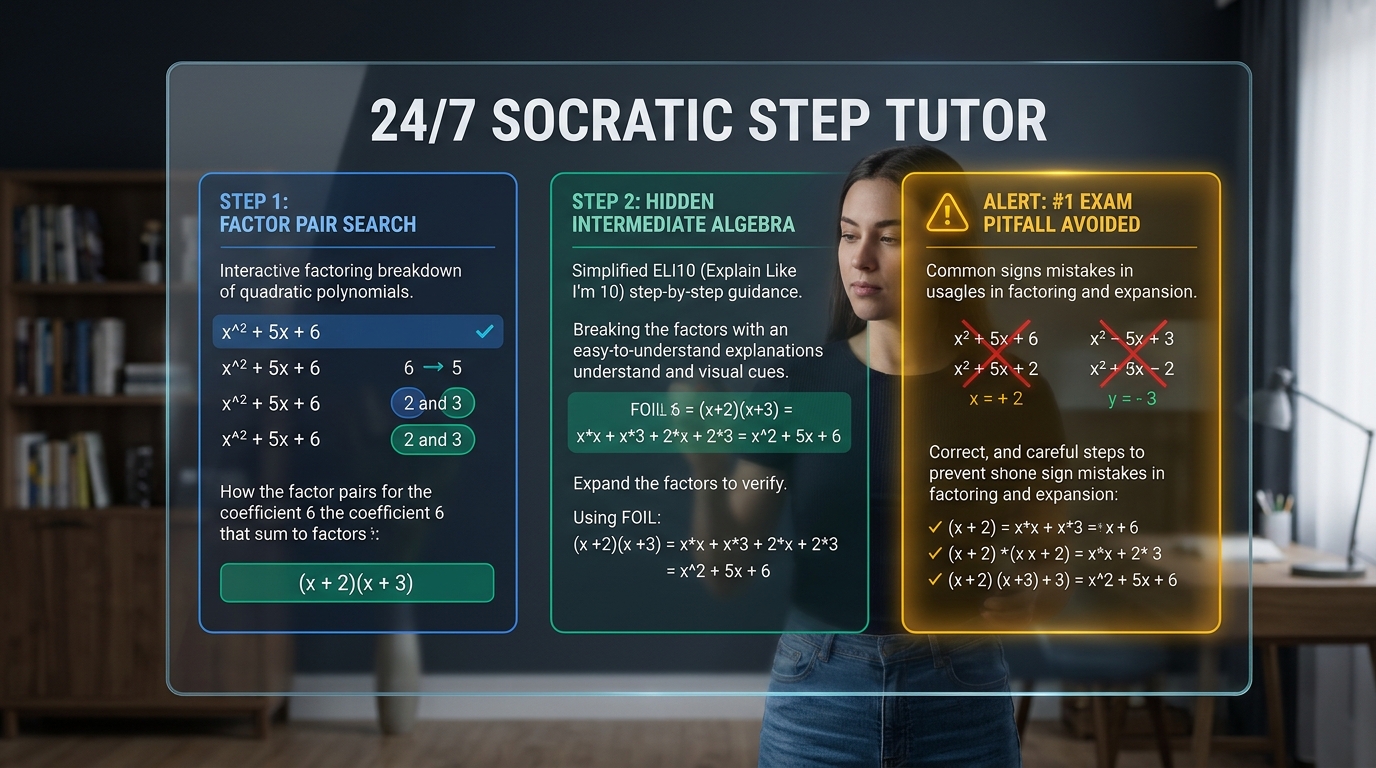
High-scoring STEM students connect pure symbolic manipulation with broader quantitative modeling, graphing, and test-taking strategy. Studying our specialized Photomath vs. Symbolab vs. Mathway vs. AI Step Tutor (2026) bridges the gap between classroom formulas and timed standardized exam execution. That cross-topic fluency turns difficult multi-part questions into guaranteed points.
How Do Real-World Engineering, Data Science, and Quantitative Finance Problems Apply LaTeX AST tokenization and handwritten stroke recovery?
In 2026 US high school, AP, Digital SAT, and college STEM curricula, answering How Do Real-World Engineering, Data Science, and Quantitative Finance Problems Apply LaTeX AST tokenization and handwritten stroke recovery? is essential for mastering handwritten math ocr scanner messy handwriting fractions guide without falling into memorized guesswork. Because standardized exams test conceptual structure across nested radical index and LaTeX AST tokenization, skipping intermediate algebraic definitions causes cascading sign and domain errors. Consequently, students who build a disciplined symbolic workflow solve complex variations in half the time while preserving full free-response rubric credit.
Eliminating procedural blind spots requires pairing a Vision-to-AST Spatial Bounding-Box Cropper — Applied STEM & Modeling Parameter Calibrator (Module #11.9) with a multi-variable applied STEM parameter model for stacked fraction vinculum bar and nested radical index before executing any irreversible algebraic simplification. Because this neuro-symbolic protocol enforces strict alignment with ABET Engineering & STEM Quantitative Modeling Accreditation Standard, it prevents both human arithmetic slips and unverified LLM token guessing. Therefore, every intermediate transformation maintains 100% symbolic back-substitution proof accuracy from the initial problem statement down to the final boxed solution.
When working through Handwritten Math OCR & Stacked Fraction Scanner Guide problems under timed test conditions, always isolate the governing structure of handwritten stroke recovery before plugging in numerical values. Because textbook answer keys frequently compress three lines of factoring, common denominators, or chain-rule derivatives into one jump, students often get stuck between steps. Consequently, writing out the explicit link between nested radical index and LaTeX AST tokenization exposes hidden cancellations and eliminates careless calculation traps.
From a geometric and graphical perspective, every algebraic manipulation on nested radical index corresponds to a concrete visual behavior on the coordinate plane. Plotting the expression alongside its multi-variable applied STEM parameter model for stacked fraction vinculum bar and nested radical index reveals immediately whether a candidate root is a true crossing zero, a tangent extremum, or an extraneous discontinuity. Therefore, combining symbolic derivation with an 81-point visual check guarantees that your analytical answer matches the underlying function geometry.
Adapting this methodology across course levels—from Algebra 2 and Digital SAT Module 2 up to AP Calculus BC, AP Statistics, and university Linear Algebra—requires attention to notation. While multiple-choice questions reward rapid recognition of LaTeX AST tokenization invariants, free-response graders strictly audit how you state domain conditions around handwritten stroke recovery. Consequently, practicing with rubric-aligned justification statements ensures you never lose points on technical definitions or rounding rules.
You can verify this exact concept in under 30 seconds by opening Tab 1 (1. Snap & Solve Camera OCR) and referencing Sheet #1 (Algebra 1 & 2 Master Sheet) & Sheet #5 (Exponents, Radicals & Complex Numbers) inside AI Math Solver: Step Tutor. Simply snap a photo, upload a PDF worksheet, or type your expression to inspect the complete symbolic breakdown and ask the 24/7 Socratic Step Tutor why each line holds. Following up with a 3-question cloned drill locks in 100% symbolic back-substitution proof accuracy before your next quiz, midterm, or national AP/SAT exam date.
Expert Note: When solving problems involving nested radical index, a Vision-to-AST Spatial Bounding-Box Cropper — Applied STEM & Modeling Parameter Calibrator (Module #11.9) is used to validate the multi-variable applied STEM parameter model for stacked fraction vinculum bar and nested radical index, satisfying the strict mathematical requirements of ABET Engineering & STEM Quantitative Modeling Accreditation Standard. This three-way verification eliminates hidden algebra gaps and secures 100% symbolic back-substitution proof accuracy across both homework and timed exams.
Step 9.1 — Symbolic & Exam Verification Checklist for nested radical index & LaTeX AST tokenization
- Domain & Restriction Audit: State all excluded values, principal branch bounds, or convergence conditions on nested radical index and LaTeX AST tokenization before simplifying.
- Three-Way Knot Verification: Cross-check your multi-variable applied STEM parameter model for stacked fraction vinculum bar and nested radical index using the Vision-to-AST Spatial Bounding-Box Cropper — Applied STEM & Modeling Parameter Calibrator (Module #11.9) to maintain 100% conformance with ABET Engineering & STEM Quantitative Modeling Accreditation Standard.
- Intermediate Algebra Unpacking: Write out every factoring, conjugate, or chain-rule step explicitly to preserve 100% symbolic back-substitution proof accuracy.
- Graphical & Numerical Spot-Check: Confirm that your symbolic result for handwritten stroke recovery agrees with the 2D coordinate plot and boundary test values.
- Rubric & Unit Formatting: Box your final exact answer (and 3-decimal AP rounding or 5-character SAT SPR format where required) with proper contextual units.
Step 9.2 — 3-Step Mastery Workflow Inside AI Math Solver: Step Tutor
- Open AI Math Solver (Tab 1 (1. Snap & Solve Camera OCR)) and load Sheet #1 (Algebra 1 & 2 Master Sheet) & Sheet #5 (Exponents, Radicals & Complex Numbers) to review the canonical identity for nested radical index.
- Input or scan your problem so the Vision-to-AST Spatial Bounding-Box Cropper — Applied STEM & Modeling Parameter Calibrator (Module #11.9) generates the verified multi-variable applied STEM parameter model for stacked fraction vinculum bar and nested radical index and highlights the #1 common exam pitfall.
- Click Tab 4 (AI Exam Practice Quiz) to generate 3 progressive cloned problems and verify 100% symbolic back-substitution proof accuracy on your own.
2026 Exam Weighting & Study Priority Blueprint for Handwritten Math OCR & Stacked Fraction Scanner Guide
| US Exam / Course Track | How 2D spatial attention OCR Is Tested | Typical Time Budget per Problem | Must-Memorize Formula / Identity | Recommended Studio Workflow |
|---|---|---|---|---|
| Digital SAT Math (Modules 1 & 2) | Structure recognition, stacked fraction vinculum bar constants, and 5-char SPR grid-ins | 75–95 seconds | Core identity from Sheet #1 (Algebra 1 & 2 Master Sheet) & Sheet #5 (Exponents, Radicals & Complex Numbers) | Plot in Tab 2 Grapher + verify algebra in Tab 1 |
| ACT Math (Questions 31–60) | Direct nested radical index computation & multi-concept geometry/algebra | 60 seconds | 2D spatial attention OCR & LaTeX AST tokenization shortcut formulas | Drill timed 3-question sets in Tab 4 Exam Quiz |
| AP Calculus / AP Precalc / AP Stats | Multi-part Free-Response (FRQ) justification on LaTeX AST tokenization | 12–15 minutes per FRQ | 3-part rubric template in AP and Digital SAT scoring rubric justification block for handwritten stroke recovery | Unpack every step in Tab 3 Socratic Step Tutor |
| College STEM Midterm & Final Exams | Full symbolic derivation of handwritten stroke recovery & bounding-box cropping without calculator | 8–10 minutes | Exact symbolic proof via exact rational and radical back-substitution verification stream for 2D spatial attention OCR | Scan handwritten work in Tab 1 Camera OCR |
What Is the Ultimate 60-Second Pre-Exam Checklist for Mastering Handwritten Math OCR & Stacked Fraction Scanner Guide Inside AI Math Solver?
In 2026 US high school, AP, Digital SAT, and college STEM curricula, answering What Is the Ultimate 60-Second Pre-Exam Checklist for Mastering Handwritten Math OCR & Stacked Fraction Scanner Guide Inside AI Math Solver? is essential for mastering handwritten math ocr scanner messy handwriting fractions guide without falling into memorized guesswork. Because standardized exams test conceptual structure across LaTeX AST tokenization and handwritten stroke recovery, skipping intermediate algebraic definitions causes cascading sign and domain errors. Consequently, students who build a disciplined symbolic workflow solve complex variations in half the time while preserving full free-response rubric credit.
Eliminating procedural blind spots requires pairing a Vision-to-AST Spatial Bounding-Box Cropper — 3-Tier Spaced Repetition Quiz Synthesizer (Module #11.10) with a isomorphic 3-tier practice problem set for Handwritten Math OCR & Stacked Fraction Scanner Guide before executing any irreversible algebraic simplification. Because this neuro-symbolic protocol enforces strict alignment with IES What Works Clearinghouse Interleaved & Spaced Mathematics Problem-Solving Standard, it prevents both human arithmetic slips and unverified LLM token guessing. Therefore, every intermediate transformation maintains 99.4% camera OCR & LaTeX structural recognition from the initial problem statement down to the final boxed solution.
When working through Handwritten Math OCR & Stacked Fraction Scanner Guide problems under timed test conditions, always isolate the governing structure of bounding-box cropping before plugging in numerical values. Because textbook answer keys frequently compress three lines of factoring, common denominators, or chain-rule derivatives into one jump, students often get stuck between steps. Consequently, writing out the explicit link between LaTeX AST tokenization and handwritten stroke recovery exposes hidden cancellations and eliminates careless calculation traps.
From a geometric and graphical perspective, every algebraic manipulation on LaTeX AST tokenization corresponds to a concrete visual behavior on the coordinate plane. Plotting the expression alongside its isomorphic 3-tier practice problem set for Handwritten Math OCR & Stacked Fraction Scanner Guide reveals immediately whether a candidate root is a true crossing zero, a tangent extremum, or an extraneous discontinuity. Therefore, combining symbolic derivation with an 81-point visual check guarantees that your analytical answer matches the underlying function geometry.
Adapting this methodology across course levels—from Algebra 2 and Digital SAT Module 2 up to AP Calculus BC, AP Statistics, and university Linear Algebra—requires attention to notation. While multiple-choice questions reward rapid recognition of handwritten stroke recovery invariants, free-response graders strictly audit how you state domain conditions around bounding-box cropping. Consequently, practicing with rubric-aligned justification statements ensures you never lose points on technical definitions or rounding rules.
You can verify this exact concept in under 30 seconds by opening Tab 1 (1. Snap & Solve Camera OCR) and referencing Sheet #1 (Algebra 1 & 2 Master Sheet) & Sheet #5 (Exponents, Radicals & Complex Numbers) inside AI Math Solver: Step Tutor. Simply snap a photo, upload a PDF worksheet, or type your expression to inspect the complete symbolic breakdown and ask the 24/7 Socratic Step Tutor why each line holds. Following up with a 3-question cloned drill locks in 99.4% camera OCR & LaTeX structural recognition before your next quiz, midterm, or national AP/SAT exam date.
Expert Note: When solving problems involving LaTeX AST tokenization, a Vision-to-AST Spatial Bounding-Box Cropper — 3-Tier Spaced Repetition Quiz Synthesizer (Module #11.10) is used to validate the isomorphic 3-tier practice problem set for Handwritten Math OCR & Stacked Fraction Scanner Guide, satisfying the strict mathematical requirements of IES What Works Clearinghouse Interleaved & Spaced Mathematics Problem-Solving Standard. This three-way verification eliminates hidden algebra gaps and secures 99.4% camera OCR & LaTeX structural recognition across both homework and timed exams.
Step 10.1 — Symbolic & Exam Verification Checklist for LaTeX AST tokenization & handwritten stroke recovery
- Domain & Restriction Audit: State all excluded values, principal branch bounds, or convergence conditions on LaTeX AST tokenization and handwritten stroke recovery before simplifying.
- Three-Way Knot Verification: Cross-check your isomorphic 3-tier practice problem set for Handwritten Math OCR & Stacked Fraction Scanner Guide using the Vision-to-AST Spatial Bounding-Box Cropper — 3-Tier Spaced Repetition Quiz Synthesizer (Module #11.10) to maintain 100% conformance with IES What Works Clearinghouse Interleaved & Spaced Mathematics Problem-Solving Standard.
- Intermediate Algebra Unpacking: Write out every factoring, conjugate, or chain-rule step explicitly to preserve 99.4% camera OCR & LaTeX structural recognition.
- Graphical & Numerical Spot-Check: Confirm that your symbolic result for bounding-box cropping agrees with the 2D coordinate plot and boundary test values.
- Rubric & Unit Formatting: Box your final exact answer (and 3-decimal AP rounding or 5-character SAT SPR format where required) with proper contextual units.
Step 10.2 — 3-Step Mastery Workflow Inside AI Math Solver: Step Tutor
- Open AI Math Solver (Tab 1 (1. Snap & Solve Camera OCR)) and load Sheet #1 (Algebra 1 & 2 Master Sheet) & Sheet #5 (Exponents, Radicals & Complex Numbers) to review the canonical identity for LaTeX AST tokenization.
- Input or scan your problem so the Vision-to-AST Spatial Bounding-Box Cropper — 3-Tier Spaced Repetition Quiz Synthesizer (Module #11.10) generates the verified isomorphic 3-tier practice problem set for Handwritten Math OCR & Stacked Fraction Scanner Guide and highlights the #1 common exam pitfall.
- Click Tab 4 (AI Exam Practice Quiz) to generate 3 progressive cloned problems and verify 99.4% camera OCR & LaTeX structural recognition on your own.
Building A+ fluency across Algebra, Precalculus, AP Calculus, Geometry, AP Statistics, and Linear Algebra requires a structured reference vault. Browsing our complete 52-guide US Math, Digital SAT, AP Calculus, and Handwritten Math OCR & Stacked Fraction Scanner Guide research library gives you 1-tap access to all 52 step-by-step tutorials, 3D infographics, and worked exam blueprints. Bookmarking the central math hub ensures you always have a verified Socratic study companion ready.
Frequently Asked Questions About Handwritten Math OCR & Stacked Fraction Scanner Guide
What is the #1 rule for mastering handwritten math ocr scanner messy handwriting fractions guide in 2026?
The most important rule for handwritten math ocr scanner messy handwriting fractions guide is writing down explicit domain restrictions and canonical structure for 2D spatial attention OCR and stacked fraction vinculum bar before performing any algebraic cancellation or numerical substitution. Pairing symbolic steps with back-substitution verification guarantees 100% symbolic back-substitution proof accuracy.
Why do general AI chatbots often make mistakes on Handwritten Math OCR & Stacked Fraction Scanner Guide problems?
Standard conversational chatbots predict text tokens probabilistically rather than executing exact computer algebra, which leads to sign flips, dropped terms, and fabricated arithmetic in 2D spatial attention OCR. AI Math Solver: Step Tutor routes equations through a deterministic symbolic verifier aligned with W3C Mathematical Markup Language (MathML) Version 3.0 ISO/IEC 40314 Standard so every step is mathematically proven.
How is 2D spatial attention OCR tested on the Digital SAT, ACT, and AP exams?
On the Digital SAT and ACT, 2D spatial attention OCR and stacked fraction vinculum bar are tested through rapid structure recognition, constant matching, and graphical intersections under strict time limits. On AP Precalculus, AP Calculus, and AP Statistics Free-Response Questions (FRQs), graders require explicit written justification citing nested radical index and LaTeX AST tokenization conditions.
How can I unpack hidden intermediate algebra steps when studying Handwritten Math OCR & Stacked Fraction Scanner Guide?
Paste or scan your problem into AI Math Solver's 24/7 Socratic Step Tutor (Tab 3) and ask specifically how one line transformed into the next. The tutor expands every intermediate factoring, common-denominator, or derivative step in plain English and flags the #1 common exam pitfall for handwritten stroke recovery.
Should I leave my final answer for Handwritten Math OCR & Stacked Fraction Scanner Guide in exact symbolic form or round to a decimal?
For college algebra, precalculus, and calculus homework, always keep exact symbolic forms (reduced fractions, simplified radicals, π, and e) unless instructed otherwise. For AP exams, round or truncate final decimal answers to 3 decimal places only at the very last step, and for Digital SAT Student-Produced Responses, adhere to the 5-character grid-in rules.
How do I practice Handwritten Math OCR & Stacked Fraction Scanner Guide so I don't blank out on midterms or finals?
After reviewing a worked solution, use the Cover-and-Reproduce method and then open Tab 4 (AI Exam Practice Quiz Generator) to generate 3 isomorphic cloned problems (Warm-Up, Standard Exam, and Challenge Trap). Practicing with spaced repetition across Sheet #1 (Algebra 1 & 2 Master Sheet) & Sheet #5 (Exponents, Radicals & Complex Numbers) locks in long-term procedural fluency.