
Algebra Word Problems Guide: Rate-Time-Distance, Work Rates, Mixture & Compound Interest
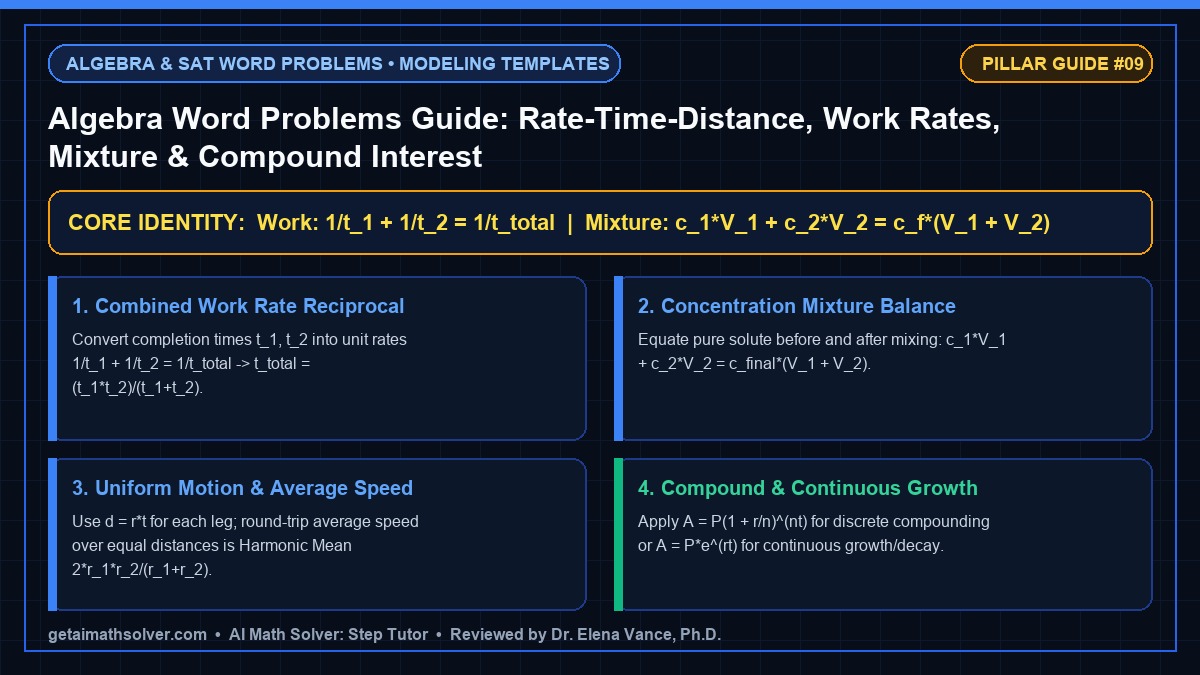
Ninety percent of Algebra, SAT, and GRE word problems map onto four conservation equations: Combined Work adds reciprocal rates (1/t₁ + 1/t₂ = 1/t_total), Solution Mixtures conserve pure solute mass (c₁V₁ + c₂V₂ = c_f(V₁ + V₂)), Uniform Motion equates distance legs (d = r·t), and Exponential Growth compounds multiplicatively via A = P(1 + r/n)^(nt).
1. Avoiding the Arithmetic Average Trap in Work & Speed Problems
Students frequently make the mistake of averaging times or speeds directly. If Pump A fills a tank in 6 hours and Pump B fills the same tank in 3 hours, they do not take (6+3)/2 = 4.5 hours together—working together must be faster than the fastest pump alone (under 3 hours)!
Always add rates (jobs per hour), never times: 1/6 + 1/3 = 1/t -> 3/6 = 1/t -> t = 2 hours. Similarly, if a car drives to a city at r₁ = 40 mph and returns along the same road at r₂ = 60 mph, the average speed for the round trip is the Harmonic Mean 2·r₁·r₂ / (r₁ + r₂) = 2(40)(60)/100 = 48 mph, not 50 mph.
2. Solution Mixture Balances & Continuous Exponential Decay
In chemistry and algebra mixture problems, track the amount of pure active ingredient: (Concentration 1 × Volume 1) + (Concentration 2 × Volume 2) = (Final Concentration × Total Volume). If pure water is added to dilute a solution, its concentration is c₂ = 0; if pure acid/salt is added, its concentration is c₂ = 1.00 (100%).
For radioactive half-life or continuous compounding A(t) = P·e^(kt), the time required to double an investment at continuous rate r is t_double = ln(2) / r ≈ 0.693 / r.
3. Quick-Reference Formula & Strategy Comparison Table
| Word Problem Archetype | Canonical Algebraic Equation | Fast Shortcut Formula |
|---|---|---|
| Two Workers / Pumps Together | 1/t₁ + 1/t₂ = 1/t_total | t_total = (t₁ · t₂) / (t₁ + t₂) |
| Round-Trip Equal Distance Speed | d_total / (d/r₁ + d/r₂) | r_avg = (2 · r₁ · r₂) / (r₁ + r₂) |
| Two-Solution Concentration Mix | c₁V₁ + c₂V₂ = c_f(V₁ + V₂) | V₁ / V₂ = |c₂ - c_f| / |c_f - c₁| (Alligation) |
| Half-Life Exponential Decay | N(t) = N₀ · (1/2)^(t / t_{1/2}) | Decay constant λ = ln(2) / t_{1/2} |
Test This Concept in the Live AI Math Solver Studio
Snap a photo of any handwritten or printed worksheet, or load our pre-built equation directly into the symbolic engine and 2D Grapher.
🚀 Solve & Plot "1/6 + 1/3 = 1/t" Now4. Frequently Asked Questions (FAQ)
What if a pipe is draining a tank while another pipe fills it?
Assign a positive rate (+1/t_fill) to the filling pipe and a negative rate (-1/t_drain) to the draining pipe: 1/t_fill - 1/t_drain = 1/t_net.
How do I set up upstream vs. downstream boat speed problems?
With boat speed b in still water and current speed c, downstream speed is (b + c) and upstream speed is (b - c). Adding both speeds and dividing by 2 recovers b.
What is the difference between simple interest and compound interest?
Simple interest grows linearly on the original principal only: A = P(1 + rt). Compound interest grows exponentially because interest earns interest: A = P(1 + r/n)^(nt).
Can AI Math Solver translate English word problems directly into equations?
Yes. Paste or photograph any multi-sentence word problem and AI Math Solver defines the variables, writes the system of equations, and solves it step-by-step.