
Digital SAT Math Module 2 Hard Problem Strategies: Constants, Systems & Quadratics (2026)
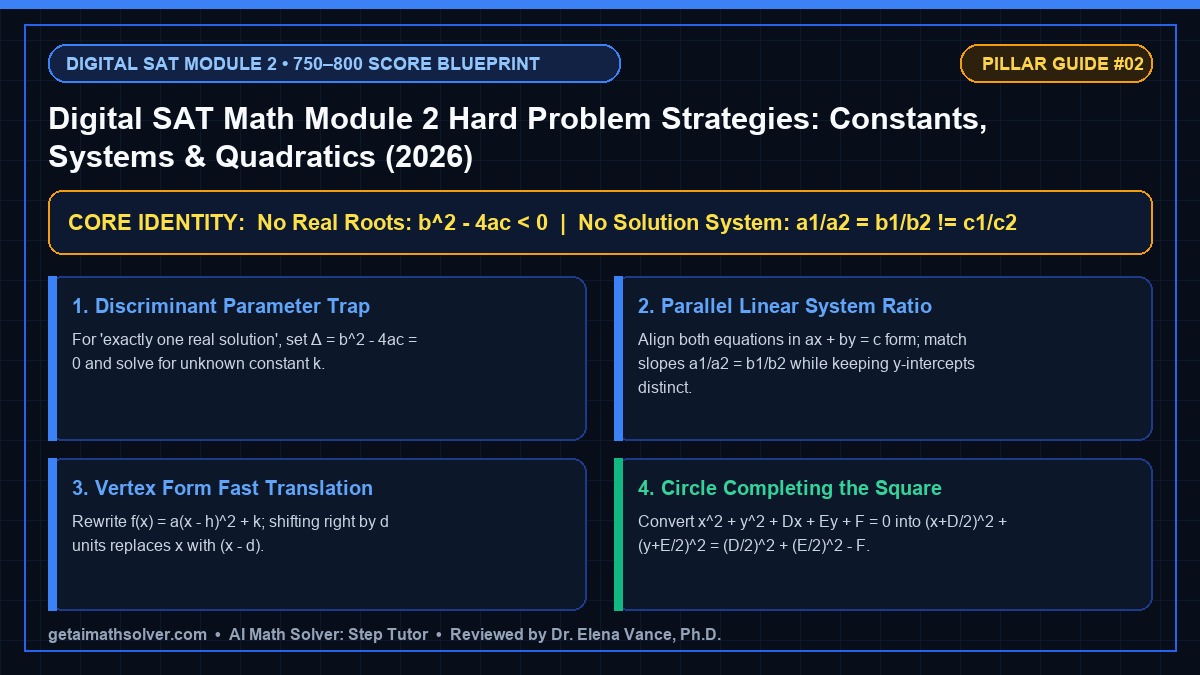
To score 750–800 on Digital SAT Math Module 2, students must master parameterized structure problems where a constant k controls the number of solutions. Over 65% of the final 7 hard Module 2 questions test three algebraic invariants: the quadratic discriminant (Δ = b² - 4ac), parallel slope ratios (a₁/a₂ = b₁/b₂ ≠ c₁/c₂), and vertex form transformations.
1. Pattern #1: Unknown Constant k in Quadratic Discriminant Problems
In Digital SAT Module 2 (Questions 16–22), the College Board frequently presents a quadratic equation mixed with a linear equation and asks for the value of constant k that yields 'exactly one real intersection point' or 'no real solutions'.
Instead of graphing blindly, combine both equations into standard form ax² + bx + c = 0 first. Then apply the discriminant Δ = b² - 4ac: set Δ > 0 for two intersections, Δ = 0 for one tangent intersection, or Δ < 0 for zero real intersections.
2. Pattern #2: Infinite vs. Zero Solutions in Parameterized Linear Systems
When two linear equations a₁x + b₁y = c₁ and a₂x + b₂y = c₂ contain an unknown constant k, avoid full substitution. First align the x and y terms on the left side in identical order.
A system has no solution (parallel lines) when the coefficient ratios match but the constant ratio differs: a₁/a₂ = b₁/b₂ ≠ c₁/c₂. It has infinitely many solutions (identical lines) when all three ratios are equal: a₁/a₂ = b₁/b₂ = c₁/c₂.
3. Quick-Reference Formula & Strategy Comparison Table
| SAT Module 2 Question Phrasing | Algebraic Invariant to Apply | Time Saved vs. Manual Plugging |
|---|---|---|
| 'Exactly one real solution / tangent line' | Set Discriminant b² - 4ac = 0 | Saves ~65 seconds |
| 'System of linear equations has no solution' | Set a₁/a₂ = b₁/b₂ ≠ c₁/c₂ | Saves ~50 seconds |
| 'Sum or product of solutions to ax²+bx+c=0' | Vieta's Formulas: Sum = -b/a, Product = c/a | Saves ~75 seconds |
| 'Maximum or minimum value of quadratic f(x)' | Evaluate vertex at h = -b/(2a), k = f(h) | Saves ~45 seconds |
Test This Concept in the Live AI Math Solver Studio
Snap a photo of any handwritten or printed worksheet, or load our pre-built equation directly into the symbolic engine and 2D Grapher.
🚀 Solve & Plot "3x^2 + 12x + k = 0" Now4. Frequently Asked Questions (FAQ)
How can I quickly find the sum of roots on the Digital SAT without factoring?
Use Vieta's Formula directly: for any quadratic ax² + bx + c = 0 with real roots r₁ and r₂, the sum of the solutions is r₁ + r₂ = -b/a and the product is r₁·r₂ = c/a.
What is the fastest way to find the radius of a circle from expanded form?
Move the constant F to the right side of x² + Dx + y² + Ey = -F, then add (D/2)² + (E/2)² to that right side to get r² directly.
When should I use algebraic steps instead of a graphing calculator on Module 2?
Whenever the problem asks for an exact symbolic fraction, an inequality boundary for an unknown parameter k, or compares two abstract constants a and b.
How do I practice Digital SAT Module 2 problems in AI Math Solver?
Open the Exam Quiz tab or Web Studio, select the SAT & Algebra category, and generate step-by-step practice problems with instant rule breakdowns.