
AP Calculus AB & BC Master Guide: Derivatives, Chain Rule, Integrals & Fundamental Theorem
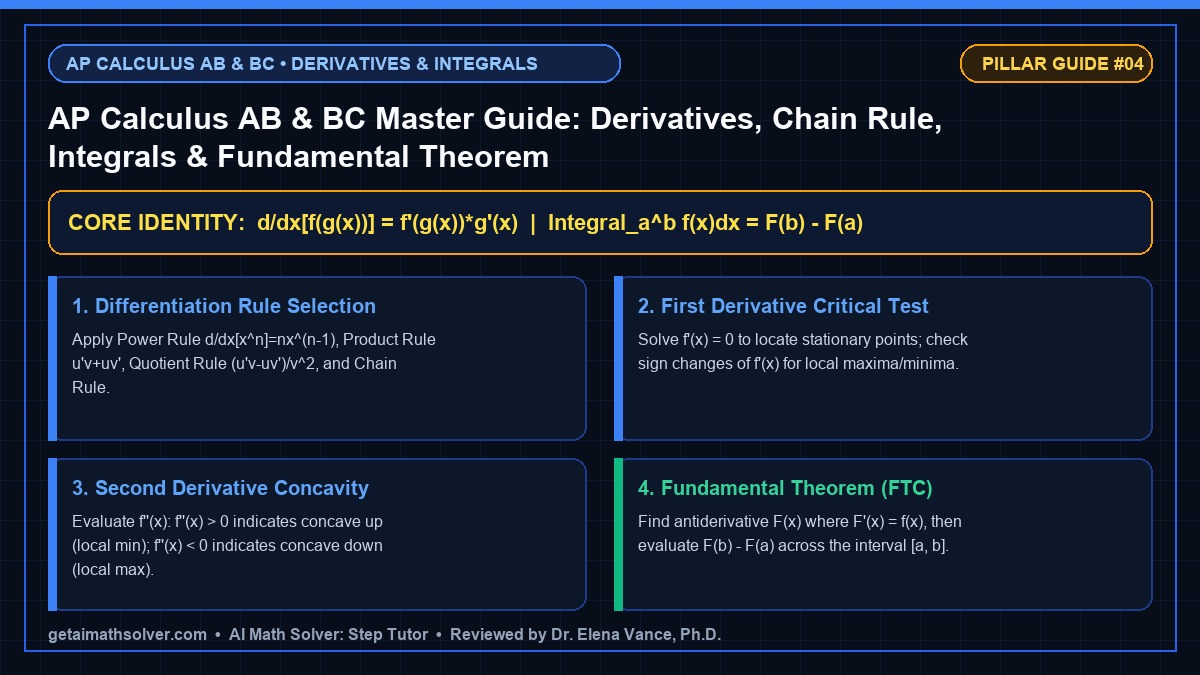
AP Calculus AB and BC revolve around two inverse operations linked by the Fundamental Theorem of Calculus (FTC): differentiation measures instantaneous rate of change and tangent slope via f'(x), while definite integration accumulates net signed area via ∫[a to b] f(x)dx = F(b) - F(a), where F'(x) = f(x).
1. Core Differentiation Rules & First/Second Derivative Optimization
On both the No-Calculator and Calculator sections of the AP Calculus exam, differentiation problems test whether you can recognize composite structures and apply the Chain Rule d/dx[f(g(x))] = f'(g(x))·g'(x) without dropping the inner derivative g'(x).
Once you compute f'(x), setting f'(x) = 0 identifies critical numbers where the tangent line is horizontal. The Second Derivative Test then classifies each critical point x = c: if f''(c) < 0, the curve is concave down and f(c) is a local maximum; if f''(c) > 0, the curve is concave up and f(c) is a local minimum.
2. Antiderivatives, u-Substitution & Integration by Parts (BC)
Integration reverses differentiation. Whenever an integrand contains a composite function multiplied by the derivative of its inner function—such as ∫ 2x·cos(x²) dx—let u equal the inner function (u = x², du = 2x dx) to collapse the integral into a basic antiderivative.
For AP Calculus BC students facing a product of two unrelated functions (such as polynomial times exponential ∫ x·eˣ dx), apply Integration by Parts: ∫ u dv = u·v - ∫ v du, choosing u using the LIATE priority order (Logarithmic, Inverse trig, Algebraic, Trigonometric, Exponential).
3. Quick-Reference Formula & Strategy Comparison Table
| Calculus Operation | Symbolic Formula | Common AP Exam Error to Avoid |
|---|---|---|
| Chain Rule | d/dx [f(g(x))] = f'(g(x)) · g'(x) | Forgetting to multiply by inner derivative g'(x) |
| Quotient Rule | d/dx [u/v] = (u'v - uv') / v² | Reversing subtraction order in numerator (uv' - u'v) |
| FTC Part 1 (Leibniz Rule) | d/dx [∫_a^{g(x)} f(t) dt] = f(g(x)) · g'(x) | Omitting g'(x) when upper bound is a function of x |
| Definite u-Substitution | ∫_a^b f(g(x))g'(x)dx = ∫_{g(a)}^{g(b)} f(u)du | Evaluating u-antiderivative at old x-bounds a and b |
Test This Concept in the Live AI Math Solver Studio
Snap a photo of any handwritten or printed worksheet, or load our pre-built equation directly into the symbolic engine and 2D Grapher.
🚀 Solve & Plot "d/dx (x^3 - 3x^2 + 2)" Now4. Frequently Asked Questions (FAQ)
Does f'(c) = 0 always guarantee a local maximum or minimum?
No. A critical point x = c is only a local extremum if the first derivative f'(x) actually changes sign (+ to - or - to +) as x passes through c. For example, f(x) = x³ has f'(0) = 0 but no local extremum at x = 0.
What is the difference between net signed area and total distance traveled?
Net displacement is the definite integral ∫[a to b] v(t) dt, whereas total distance traveled requires integrating the absolute speed ∫[a to b] |v(t)| dt by splitting at zeros of v(t).
When do I use L'Hôpital's Rule on the AP Calculus exam?
Use L'Hôpital's Rule only when direct substitution into a limit yields the indeterminate form 0/0 or ±∞/∞. Always write lim f(x) = 0 and lim g(x) = 0 explicitly on Free Response questions.
Can AI Math Solver compute both derivatives and definite integrals step-by-step?
Yes. Prefix your expression with d/dx for derivatives or int for integrals, or scan a printed calculus problem directly with the camera.