
Differential Equations & Laplace Transforms Guide: Separable ODEs, Integrating Factors & IVPs
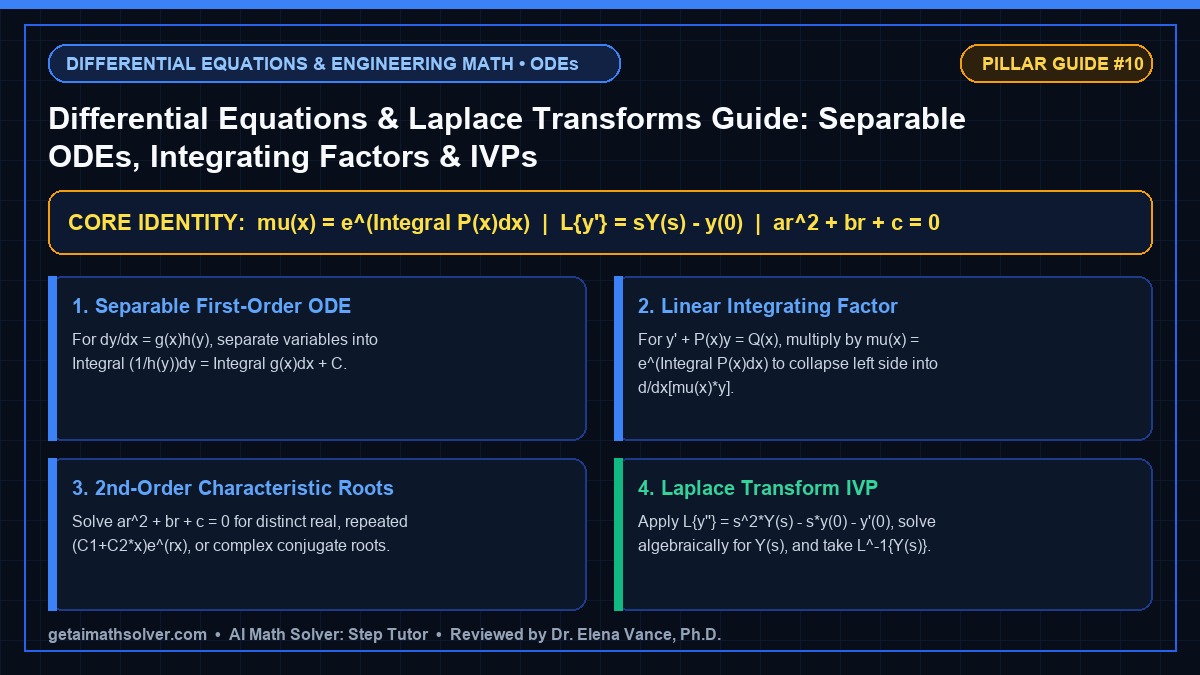
Ordinary Differential Equations (ODEs) model dynamic systems across AP Calculus BC, physics, and engineering. First-order equations are solved by separation of variables (∫ dy/h(y) = ∫ g(x)dx) or the integrating factor μ(x) = e^(∫P(x)dx), while constant-coefficient Initial Value Problems (IVPs) are converted into algebraic s-domain equations via the Laplace Transform L{y'(t)} = sY(s) - y(0).
1. Separable ODEs (AP Calculus BC) & First-Order Integrating Factors
On the AP Calculus BC Free Response exam, separation of variables accounts for up to 5–6 points on a single question. Whenever dy/dx can be factored as a product g(x)·h(y), move all y terms to the left with dy and all x terms to the right with dx, integrate both sides, and apply the initial condition y(x₀) = y₀ immediately to find C.
When y and x cannot be separated multiplicative-wise—specifically in the standard linear form dy/dx + P(x)y = Q(x)—multiply every term by the Integrating Factor μ(x) = e^(∫P(x)dx). By the Product Rule in reverse, the left-hand side always collapses into d/dx[μ(x)·y] = μ(x)·Q(x).
2. Second-Order Characteristic Roots & Laplace Transform Table
For a homogeneous second-order linear ODE a·y'' + b·y' + c·y = 0, substituting the trial solution y = e^(rx) yields the auxiliary quadratic ar² + br + c = 0. Two real roots r₁ ≠ r₂ give y = C₁e^(r₁x) + C₂e^(r₂x); a repeated root r gives y = (C₁ + C₂x)e^(rx); complex roots α ± βi give y = e^(αx)[C₁cos(βx) + C₂sin(βx)].
When initial conditions y(0) and y'(0) are given along with discontinuous forcing functions (step or impulse inputs), the Laplace Transform L{f(t)} = ∫₀^∞ e^(-st)f(t)dt converts differentiation in time t into multiplication by s in the frequency domain.
3. Quick-Reference Formula & Strategy Comparison Table
| Time Function f(t) (t ≥ 0) | Laplace Transform F(s) = L{f(t)} | Region of Convergence |
|---|---|---|
| 1 (Unit Step) | 1 / s | s > 0 |
| tⁿ (Positive Integer n) | n! / s^(n + 1) | s > 0 |
| e^(at) (Exponential) | 1 / (s - a) | s > a |
| sin(ωt) and cos(ωt) | ω / (s² + ω²) and s / (s² + ω²) | s > 0 |
| First & Second Derivatives | sY(s) - y(0) and s²Y(s) - sy(0) - y'(0) | Incorporates initial state directly |
Test This Concept in the Live AI Math Solver Studio
Snap a photo of any handwritten or printed worksheet, or load our pre-built equation directly into the symbolic engine and 2D Grapher.
🚀 Solve & Plot "dy/dx = 2xy" Now4. Frequently Asked Questions (FAQ)
Why do I lose points on AP Calculus BC if I don't separate variables first?
The College Board rubric states that if a student does not separate the variables correctly in Step 1, the response is eligible for 0 out of 5 or 6 points on that part—even if the final expression looks similar.
Should I include a +C on both sides when integrating a separable ODE?
You only need to write +C₁ on the independent variable (x) side, since combining constants from both sides yields a single arbitrary constant C.
Why must the coefficient of dy/dx equal 1 before finding the integrating factor?
In a(x)y' + b(x)y = c(x), the product rule collapse d/dx[μy] requires the standard form y' + P(x)y = Q(x) where P(x) = b(x)/a(x). Forgetting to divide by a(x) produces the wrong exponent in μ(x).
How do I solve an ODE in AI Math Solver?
Type the differential equation such as dy/dx = 2xy or y'' - 3y' + 2y = 0 into the AI Math Solver input box for a full symbolic solution.