
Unit Circle & Trigonometry Identities Guide: Exact Radian Values, Pythagorean & Double-Angle
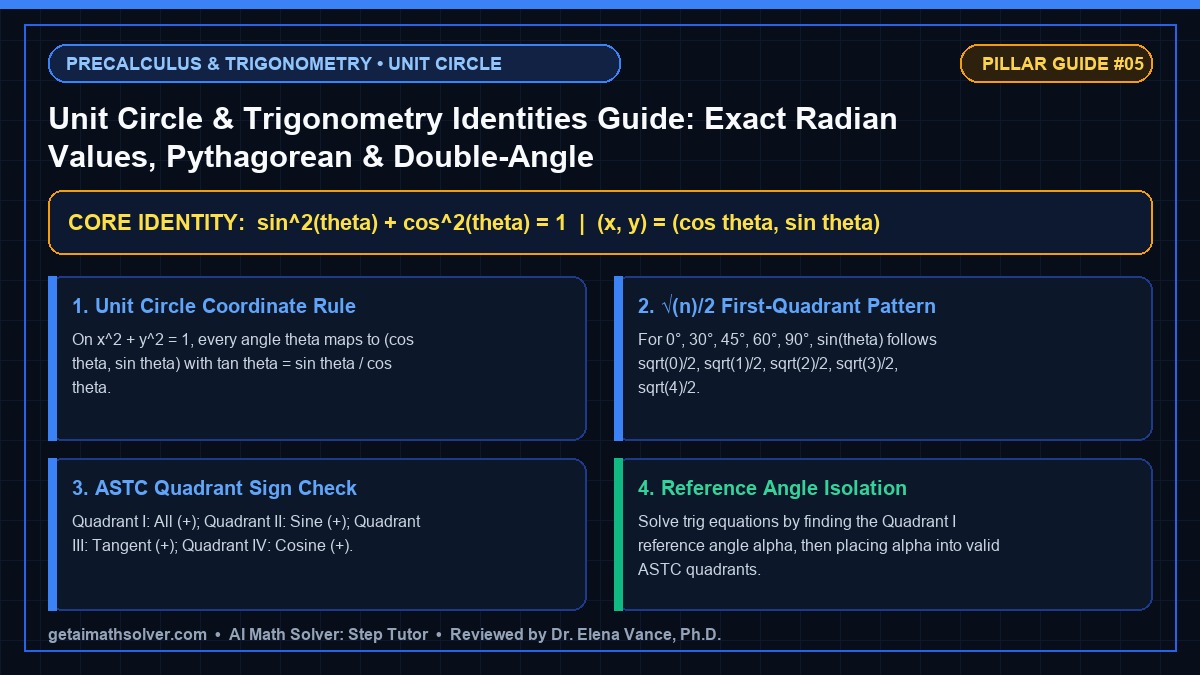
On the Unit Circle (x² + y² = 1), any angle θ measured counterclockwise from the positive x-axis intersects the circle at coordinates (cos θ, sin θ). Combining this geometric definition with the Pythagorean theorem yields the fundamental identity sin²(θ) + cos²(θ) = 1, from which all reciprocal, quotient, and double-angle identities are derived.
1. The √n / 2 Shortcut for Exact First-Quadrant Values
You never need to memorize 16 separate unit circle coordinates by rote. Simply remember the five benchmark angles in Quadrant I: 0° (0), 30° (π/6), 45° (π/4), 60° (π/3), and 90° (π/2).
Across those five angles, sin(θ) counts upward as √0/2, √1/2, √2/2, √3/2, √4/2 (which simplifies to 0, 1/2, √2/2, √3/2, 1), while cos(θ) counts backward from 1 down to 0. Dividing sin(θ) by cos(θ) gives tan(θ) = 0, √3/3, 1, √3, and undefined.
2. Solving Trigonometric Equations on [0°, 360°) Without Missing Roots
When solving an equation such as 2·sin(θ) - 1 = 0 on [0°, 360°), pressing arcsin(0.5) on a calculator returns only one answer (30°). However, every non-extremum sine or cosine value occurs in two quadrants over a full period.
Always follow the two-step ASTC protocol: first find the acute reference angle α = arcsin(|k|), and second place α into both quadrants where the trig function has the required sign (Quadrant I: θ = α; Quadrant II: θ = 180° - α; Quadrant III: θ = 180° + α; Quadrant IV: θ = 360° - α).
3. Quick-Reference Formula & Strategy Comparison Table
| Angle θ (Degrees) | Angle θ (Radians) | cos(θ) (x-coord) | sin(θ) (y-coord) | tan(θ) = sin/cos |
|---|---|---|---|---|
| 0° | 0 | 1 | 0 | 0 |
| 30° | π / 6 | √3 / 2 | 1 / 2 | √3 / 3 |
| 45° | π / 4 | √2 / 2 | √2 / 2 | 1 |
| 60° | π / 3 | 1 / 2 | √3 / 2 | √3 |
| 90° | π / 2 | 0 | 1 | Undefined (Asymptote) |
Test This Concept in the Live AI Math Solver Studio
Snap a photo of any handwritten or printed worksheet, or load our pre-built equation directly into the symbolic engine and 2D Grapher.
🚀 Solve & Plot "2*sin(theta) - 1 = 0" Now4. Frequently Asked Questions (FAQ)
How do I convert between degrees and radians quickly?
Multiply degrees by π/180° to get radians, or multiply radians by 180°/π to get degrees. Remember the anchor identity π radians = 180°.
How do I derive the tangent and secant Pythagorean identities?
Start with sin²(θ) + cos²(θ) = 1. Divide every term by cos²(θ) to get tan²(θ) + 1 = sec²(θ), or divide every term by sin²(θ) to get 1 + cot²(θ) = csc²(θ).
When should I use Law of Sines vs. Law of Cosines?
Use Law of Sines (a/sin A = b/sin B) when you know a matching angle-side pair (AAS, ASA, SSA). Use Law of Cosines (c² = a² + b² - 2ab·cos C) for SAS or SSS triangles.
Why do complementary angles have equal sine and cosine?
In any right triangle, the two acute angles sum to 90°, so the side opposite angle θ is adjacent to angle (90° - θ). Thus sin(θ) = cos(90° - θ).