
Linear Algebra Systems of Equations, Matrices & Cramer's Rule Guide (2×2 & 3×3 Determinants)
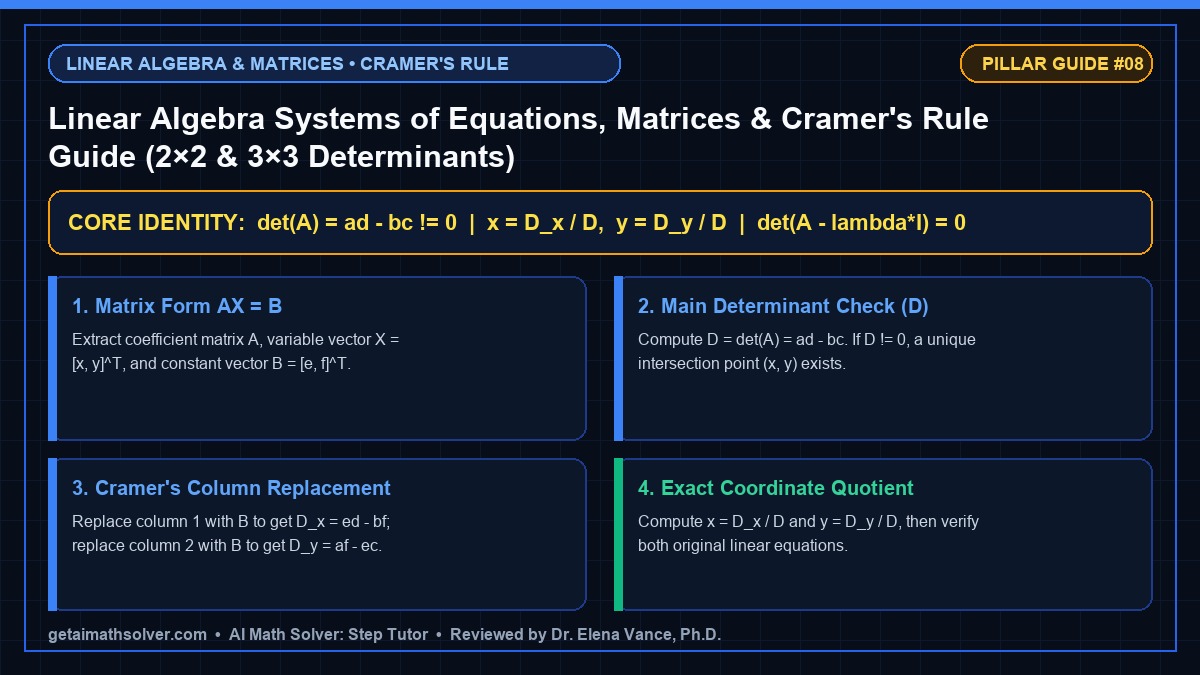
Any 2×2 system of linear equations ax + by = e and cx + dy = f can be represented in matrix form as AX = B. Whenever the coefficient determinant D = det(A) = ad - bc is non-zero, the system has a unique solution given directly by Cramer's Rule: x = Dₓ / D = (ed - bf)/(ad - bc) and y = Dᵧ / D = (af - ec)/(ad - bc).
1. Elimination vs. Cramer's Rule vs. Matrix Inverse A⁻¹
When coefficients are small integers with matching or opposite signs (such as 2x + y = 7 and x - y = 2), linear combination (elimination) solves the system in two lines by adding the equations together.
When coefficients involve fractions, decimals, or symbolic parameters, Cramer's Rule and the 2×2 Matrix Inverse A⁻¹ = (1 / det(A)) · [[d, -b], [-c, a]] prevent algebraic fraction errors because you compute determinants using pure multiplication and subtraction before dividing once at the very end.
2. Characteristic Polynomial & Eigenvalues: det(A - λI) = 0
In college Linear Algebra and Differential Equations, a scalar λ is an eigenvalue of square matrix A if there exists a non-zero eigenvector v such that Av = λv, or equivalently (A - λI)v = 0.
For a non-trivial eigenvector v ≠ 0 to exist, the matrix (A - λI) must be singular, meaning its determinant must equal zero: det(A - λI) = 0. For any 2×2 matrix A, this expands into the quadratic characteristic equation λ² - tr(A)·λ + det(A) = 0, where tr(A) = a + d is the trace.
3. Quick-Reference Formula & Strategy Comparison Table
| Determinant Condition | Matrix Invertibility | Linear System AX = B Outcome |
|---|---|---|
| det(A) ≠ 0 | A is Invertible (Non-Singular, Full Rank) | Unique solution X = A⁻¹B (Intersecting lines/planes) |
| det(A) = 0 and Dₓ = Dᵧ = 0 | A is Singular (Rank Deficient) | Infinitely many solutions (Coincident lines) |
| det(A) = 0 and Dₓ ≠ 0 or Dᵧ ≠ 0 | A is Singular (Inconsistent) | No solution (Parallel non-intersecting lines) |
Test This Concept in the Live AI Math Solver Studio
Snap a photo of any handwritten or printed worksheet, or load our pre-built equation directly into the symbolic engine and 2D Grapher.
🚀 Solve & Plot "2x + y = 7, x - y = 2" Now4. Frequently Asked Questions (FAQ)
How do I remember the 2×2 inverse matrix formula?
Swap the main diagonal entries (a and d), negate the off-diagonal entries (-b and -c), and divide every entry by the determinant ad - bc.
What does the trace of a matrix tell you about its eigenvalues?
For any n×n matrix A, the sum of all its eigenvalues equals the trace tr(A) (sum of diagonal entries), and the product of all its eigenvalues equals det(A).
Can Cramer's Rule be used when det(A) = 0?
No. When det(A) = 0, division by D is undefined because the system either has no solutions or infinitely many solutions; use Gaussian row reduction (RREF) instead.
How do I enter a system of equations in AI Math Solver?
Separate the equations with a comma or semicolon (for example, 2x + y = 7, x - y = 2) or scan the bracketed system from your page.