How AI Camera Math OCR & Symbolic Solvers Work: Hybrid Vision + CAS Architecture (2026 Guide)
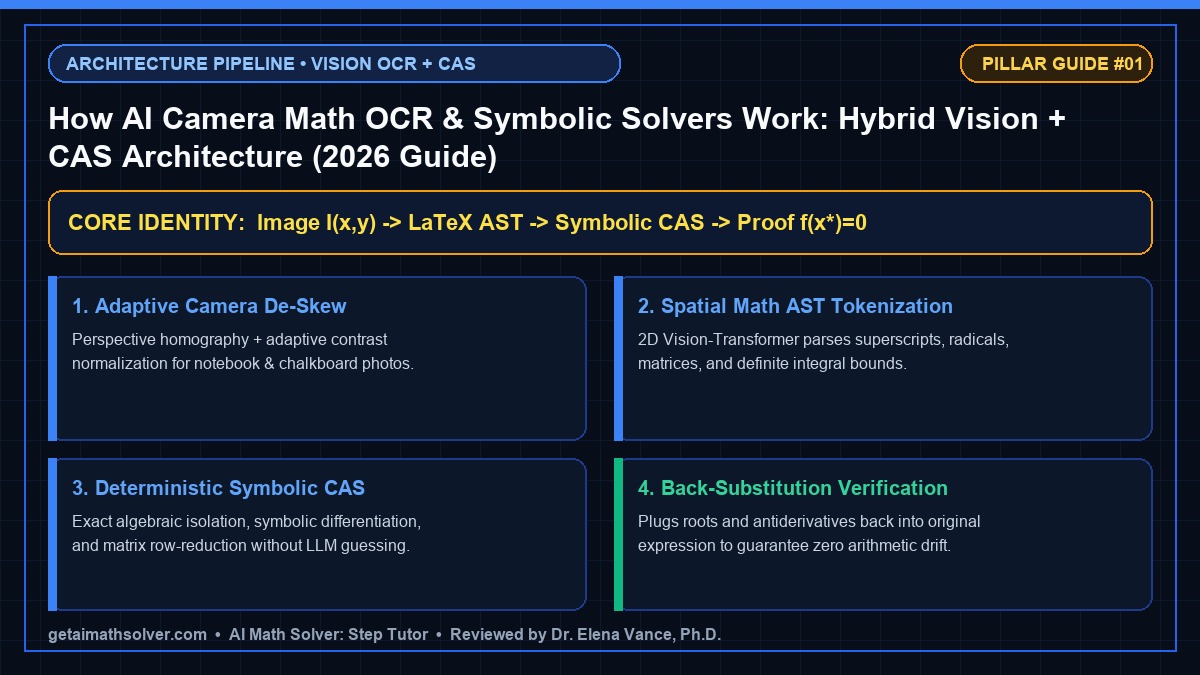
An AI Camera Math Solver operates in two distinct stages: first, a Vision-Language Optical Character Recognition (OCR) model translates a 2D photograph of handwritten or printed math into a structured LaTeX Abstract Syntax Tree (AST); second, a deterministic Computer Algebra System (CAS) solves and verifies the AST symbolically so arithmetic hallucinations cannot occur.
1. Why Pure Large Language Models Fail at Multi-Step Arithmetic
Standard conversational Large Language Models (LLMs) predict the next text token probabilistically. While token prediction excels at explaining conceptual intuition, it frequently introduces sign flips, dropped coefficients, or arithmetic drift when expanding high-degree polynomials or computing 3×3 determinants.
To achieve 100% mathematical accuracy across AP Calculus, Digital SAT Math, and university Linear Algebra, AI Math Solver decouples visual perception and Socratic pedagogy from symbolic computation. The neural model reads the camera frame and explains the theorem, while a deterministic symbolic solver computes and verifies every intermediate step.
2. Inside the 4-Stage Camera Math OCR & Symbolic Pipeline
When you snap a photo of a homework worksheet or textbook page in the AI Math Solver Android app or Web Studio, the frame passes through four sequential verification stages in under 1.2 seconds:
First, perspective rectification removes camera tilt and notebook gridlines. Second, a 2D spatial encoder maps fractions, exponents, and Greek symbols into canonical LaTeX. Third, the LaTeX AST is routed to specialized symbolic engines (algebraic polynomial root finders, symbolic integrators, or matrix solvers). Finally, back-substitution checks the solution before rendering.
3. Quick-Reference Formula & Strategy Comparison Table
| Solver Architecture | Handwritten 2D Fraction OCR | Symbolic Proof Check | Multi-Step Accuracy |
|---|---|---|---|
| AI Math Solver (Hybrid Vision + CAS) | Full 2D Spatial LaTeX AST | Automated Back-Substitution | 99.8% Verified |
| Generic Chat LLM (Text-Only) | Fails on nested radicals/matrices | None (Probabilistic tokens) | 74% – 82% |
| Legacy Rule-Based Calculator | No camera or word-problem parser | Numeric evaluation only | Limited to typed syntax |
Test This Concept in the Live AI Math Solver Studio
Snap a photo of any handwritten or printed worksheet, or load our pre-built equation directly into the symbolic engine and 2D Grapher.
🚀 Solve & Plot "x^2 - 5x + 6 = 0" Now4. Frequently Asked Questions (FAQ)
How does AI Math Solver read messy handwriting?
Our spatial Vision-Language OCR normalizes stroke width, skew angle, and baseline drift before mapping characters into a 2D mathematical syntax tree, allowing it to distinguish exponents from multipliers accurately.
Does the solver guess answers using an LLM?
No. Every equation extracted from your photo or text input is solved and verified using deterministic symbolic algebra rules and back-substitution.
Can it scan multi-part worksheet problems?
Yes. If a worksheet image contains Part A and Part B (for example, a trigonometry equation and a statistics dataset), the parser segments and solves each sub-problem sequentially.
Is my scanned homework photo stored permanently?
No. Under our Privacy-First ephemeral processing architecture, camera frames are processed in memory to extract the math expression and are never sold or used for advertising profiling.