
Quadratic Equations, Discriminant & Vertex Form Complete Guide (Factoring, Formula & Graphs)
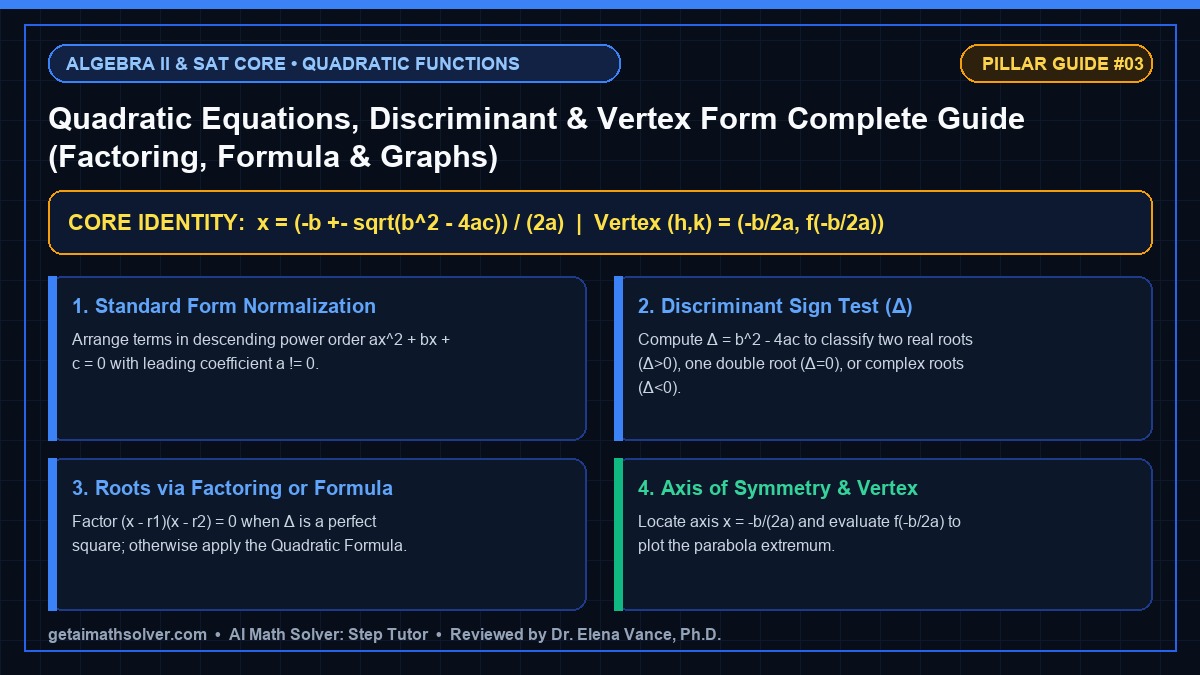
Every quadratic equation in standard form ax² + bx + c = 0 (where a ≠ 0) can be solved exactly using the Quadratic Formula x = [-b ± √(b² - 4ac)] / (2a). Its graph is a parabola whose axis of symmetry lies at x = -b/(2a), with vertex coordinates (h, k) = (-b/2a, c - b²/4a).
1. Three Equivalent Forms of a Quadratic Function
Depending on what a problem asks you to find—y-intercept, x-intercepts (roots), or maximum/minimum height—one of the three algebraic forms of a parabola will reveal the answer by inspection without extra computation.
Standard Form f(x) = ax² + bx + c immediately reveals the y-intercept at (0, c). Factored Form f(x) = a(x - r₁)(x - r₂) exposes the x-intercepts at x = r₁ and x = r₂. Vertex Form f(x) = a(x - h)² + k immediately gives the vertex extremum at (h, k).
2. How the Discriminant Δ = b² - 4ac Controls Parabola Geometry
The expression underneath the radical in the quadratic formula, Δ = b² - 4ac, determines how many times the parabola crosses the horizontal x-axis.
When Δ > 0 and is a perfect square (such as 1, 4, 9, 25), the quadratic factors cleanly over the rational numbers. When Δ > 0 is not a perfect square, the parabola crosses the x-axis at two conjugate irrational points. When Δ = 0, the vertex sits directly on the x-axis. When Δ < 0, the parabola never touches the real x-axis and yields two complex conjugate roots.
3. Quick-Reference Formula & Strategy Comparison Table
| Discriminant Value (Δ = b² - 4ac) | Root Classification | Parabola x-Axis Intersection |
|---|---|---|
| Δ > 0 (Perfect Square, e.g., Δ = 1, 9, 25) | 2 Distinct Rational Roots | Crosses x-axis at 2 rational points |
| Δ > 0 (Non-Square, e.g., Δ = 5, 12) | 2 Distinct Irrational Roots | Crosses x-axis at 2 radical points |
| Δ = 0 | 1 Repeated Real Root (Double Root) | Vertex is tangent to the x-axis |
| Δ < 0 | 2 Complex Conjugate Roots (α ± βi) | No real x-intercepts (entirely above/below x-axis) |
Test This Concept in the Live AI Math Solver Studio
Snap a photo of any handwritten or printed worksheet, or load our pre-built equation directly into the symbolic engine and 2D Grapher.
🚀 Solve & Plot "x^2 - 5x + 6 = 0" Now4. Frequently Asked Questions (FAQ)
When is completing the square faster than the quadratic formula?
Completing the square is fastest when a = 1 and b is an even integer (for example, x² + 6x - 7 = 0 becomes (x + 3)² = 16 -> x = -3 ± 4), or when converting to Vertex Form.
How do I tell if a parabola opens upward or downward?
Check the sign of the leading coefficient a: if a > 0, the parabola opens upward and the vertex is a global minimum; if a < 0, it opens downward and the vertex is a global maximum.
What are Vieta's formulas for a quadratic equation?
For ax² + bx + c = 0 with roots r₁ and r₂, the sum of roots is r₁ + r₂ = -b/a and the product of roots is r₁·r₂ = c/a.
Can AI Math Solver plot the parabola and roots simultaneously?
Yes. Entering any quadratic equation in AI Math Solver automatically plots the curve, highlights the real roots on the x-axis, and marks the vertex (h, k) on the 2D Grapher.